.avif)
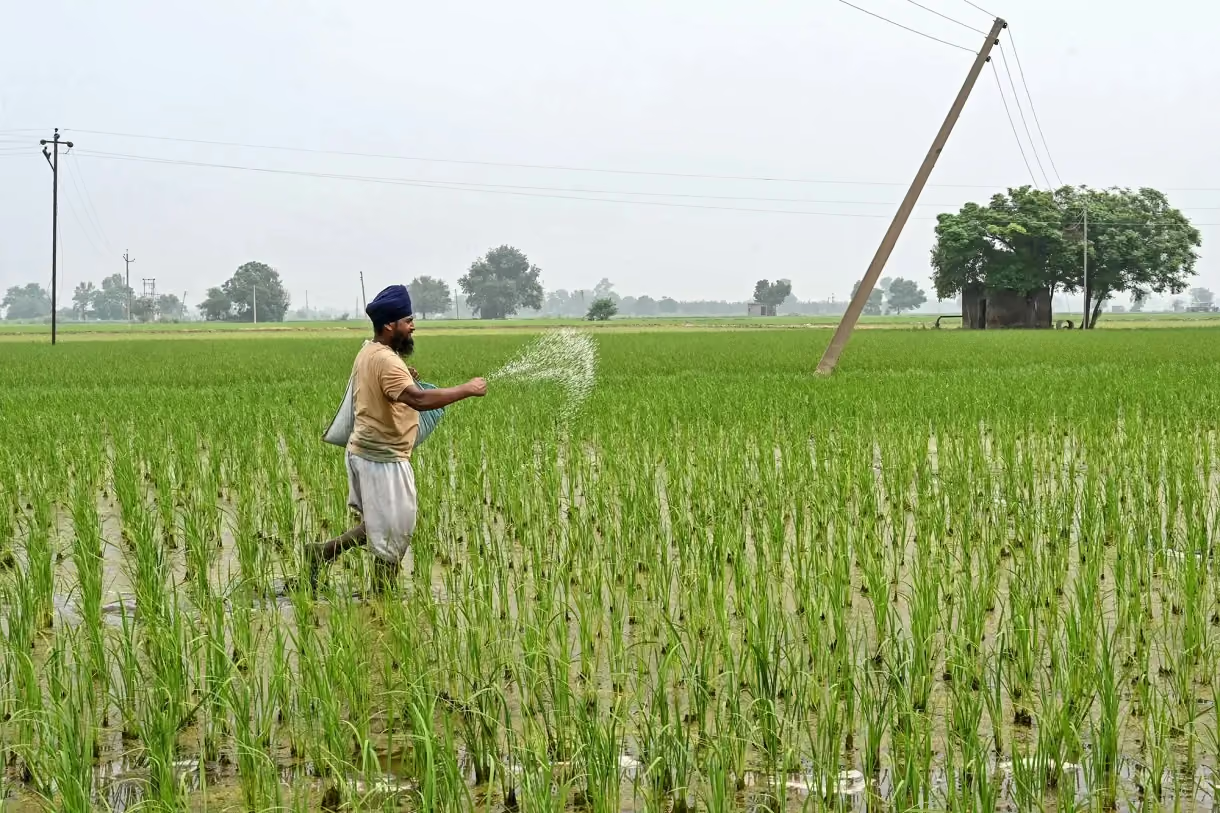
Indian fertilizer importers and state-linked procurement agencies face a widening subsidy gap of potentially Rs 3,700 or more per bag on urea a liability that sits on their balance sheets from the moment of procurement until government reimbursement arrives, which historically takes six to eighteen months.
India's fertilizer subsidy architecture works like this: the central government fixes a maximum retail price (MRP) the price a farmer pays at the last-mile retail point and then pays the difference between that MRP and the actual cost of procurement to the fertilizer company or importer. For urea, the MRP has been held at Rs 266.5 per 45 kg bag since 2012. International urea prices, according to government officials at the April 28 inter-ministerial briefing, have now "exceeded Rs 4,000 per bag" a figure consistent with the near-doubling of global tender prices attributed to the West Asia crisis. The subsidy per bag technically the difference between the government notified cost plus price and the MRP, reimbursed through the New Pricing Scheme (NPS) is therefore not a rounding error. It is the entire economics of the trade. At roughly Rs 3,700 plus per bag, the government is paying approximately fifteen times what the farmer pays.
The physical supply chain tells part of the story. India imports urea primarily via bulk cargo vessels typically Handymax or Supramax vessels carrying 25,000 to 55,000 tonnes loading at origin ports in the Middle East, North Africa, and Eastern Europe, with a typical voyage to Indian ports like Kandla, Paradip, or Kakinada running between 12 and 25 days depending on origin. Urea from the Arab Gulf has historically dominated: shorter haul, lower freight cost, established supplier relationships. The West Asia crisis, according to reports, has disrupted this corridor. India is now actively diversifying to North African origins (Egypt), Eastern European origins (where available), and Southeast Asian spot purchases each involving meaningfully longer voyage distances, higher freight costs per tonne, and less predictable supply scheduling. A 55,000 tonne Supramax cargo from Egypt to Kandla runs roughly 18–22 days at sea versus 10–14 days from the Gulf. At current dry bulk freight rates, that differential adds approximately $8–12 per tonne to the landed cost a figure the subsidy system must absorb, not the farmer.
Here is where the margin anatomy becomes critical for fertilizer importers. Consider a mid-sized Indian fertilizer importer not a state giant like IFFCO (Indian Farmers Fertiliser Cooperative) or RCF (Rashtriya Chemicals and Fertilizers), but a licensed private importer participating in government procurement tenders. That importer procures a 30,000 tonne urea cargo at current spot rates call it $420/tonne FOB (free on board meaning the price at the origin port, before freight and insurance). Add $55/tonne freight and insurance to Kandla: landed cost is approximately $475/tonne, or roughly Rs 3,950 per 45 kg bag at current exchange rates. The government's NPS reimbursement is eventually Rs 3,700 plus per bag. But the importer must pay for the cargo on presentation of shipping documents typically via a letter of credit (LC), a bank guarantee that payment is made once documents are presented before a single rupee of subsidy has been disbursed. The working capital gap on a 30,000 tonne cargo is approximately Rs 118 crore (around $14 million), sitting on the importer's books for six to eighteen months. At current Indian short-term borrowing rates of around 9–10%, that is a financing cost of Rs 11–18 crore per cargo cycle, with no guaranteed reimbursement timeline.
The government's headline stock figures look reassuring. Urea availability of 71.58 lakh metric tonnes (LMT) against a Kharif 2026 season requirement of 18.17 LMT, DAP (di-ammonium phosphate a key phosphatic fertilizer) of 22.35 LMT against 5.90 LMT, and total Kharif buffer stocks at approximately 49% of the full season requirement of 390.54 LMT well above the typical 33% opening level. These numbers reflect genuine advance procurement discipline. But they are national aggregate figures at the central warehouse and port level. The risk is not that India runs out of urea in aggregate. The risk is that importers squeezed by working capital costs become selective about which distribution channels they replenish, and last-mile availability in remote districts frays even as port-level stocks look ample.
India's fertilizer distribution chain runs:
1. Port
2. Central warehouse
3. State government godowns
4. District cooperative or retailer
5. Farmer.
Each link adds time and cost. Stress at the importer financing level propagates downstream with a lag that national headlines do not capture.
On the buy side: state procurement agencies and the Department of Fertilizers, which runs the government tender process, have secured comfortable volumes for now. Their immediate commercial challenge is not availability it is fiscal: subsidy outgo for Kharif 2026 will materially exceed budget estimates if global prices hold. For the Union Budget, fertilizer subsidy was estimated at approximately Rs 1.64 lakh crore for 2025–26. If urea procurement costs have effectively doubled, the actual outgo could overshoot by Rs 30,000–50,000 crore or more across the full year, depending on import volumes and price trajectory. On the sell side: non-Gulf origin exporters Egyptian, Algerian, Omani (to the extent routes are unaffected), and spot-market traders holding Russian or Central Asian tonnes have gained meaningful pricing leverage. India's diversification imperative is real and urgent. That gives alternative-origin sellers the ability to shade prices slightly above historical norms while remaining competitive with Gulf-origin cargoes that now carry a security premium. The margin uplift for qualifying alternative-origin exporters is modest perhaps $10–20/tonne but on volumes of this scale, it is commercially significant.
For a large integrated fertilizer trading house an Ameropa, OCI Global, or Helm AG with derivatives access and multi-origin procurement capability, the current environment offers a specific positioning opportunity. The Middle East disruption has widened the spread between Gulf-origin urea (spot market, risk-premium inflated) and non-Gulf-origin urea (still priced on fundamentals). A trader that has pre-positioned North African or Eastern European supply can arbitrage this spread against Indian government tender requirements, offering delivered prices below the tender-discovered rate while capturing a margin the spot Gulf market cannot match. For a smaller regional fertilizer importer a licensed Indian private company without derivatives access or pre-positioned supply the priority is bilateral: negotiate extended payment terms with suppliers (60–90 days instead of standard LC at sight), pre-agree with their bank a working capital facility sized to the maximum subsidy receivable, and flag the receivable formally to their state nodal agency to establish documentary priority in the reimbursement queue. The worst outcome is procuring at elevated cost and then waiting at the back of the reimbursement line.
The historical anchor matters here. India's fertilizer subsidy system expanded dramatically after the 2008 commodity price shock, when global urea prices spiked to over $700/tonne from under $200/tonne in two years. That episode produced exactly the financing bottleneck now visible in embryonic form: private importers pulled back, IFFCO stepped in as buyer of last resort, and the government's subsidy arrears ballooned to over Rs 20,000 crore by 2010 a figure that depressed the balance sheets of fertilizer companies for years. The current situation is not yet at that scale. But the structural mechanism is identical: price shock, fixed MRP, widening subsidy liability, delayed reimbursement, working capital stress. The 2008 cycle resolved only after the government made emergency off-budget disbursements and allowed limited MRP adjustments on non-urea products. Observers should watch whether DAP and MOP (muriate of potash a potassic fertilizer used to improve crop yield and disease resistance) MRPs which have been adjusted in past crises even when urea was held fixed come under review as the season progresses.
For observers tracking this situation in real time, the most specific early-warning signal is the government's monthly fertilizer dispatch data published by the Department of Fertilizers, typically released within the first week of the following month. A divergence between port-level availability (which will remain high) and district-level dispatch rates (which will show stress first) would confirm that the working capital constraint is propagating into the distribution chain. Watch the May 2026 dispatch data, due by early June. A second signal is the India urea tender price series published by Fertilizer Week and ICIS if the next tender, expected in May–June to secure second-half Kharif supply, clears at prices above $440/tonne CFR (cost and freight meaning cost plus shipping to Indian port), it will confirm that procurement cost pressure is structural rather than temporary, and that subsidy outgo projections will need to be revised materially upward before the Union Budget mid-year review.
.jpg)


'%3e%3cg id='Final-Copy-2_2_' transform='translate(1275.000000, 200.000000)'%3e%3cpath class='st0' d='M7.4,12.8h6.8l3.1-11.6H7.4C4.2,1.2,1.6,3.8,1.6,7S4.2,12.8,7.4,12.8z'/%3e%3c/g%3e%3c/g%3e%3c/g%3e%3cg id='final---dec.11-2020'%3e%3cg id='_x30_208-our-toggle' transform='translate(-1275.000000, -200.000000)'%3e%3cg id='Final-Copy-2' transform='translate(1275.000000, 200.000000)'%3e%3cpath class='st1' d='M22.6,0H7.4c-3.9,0-7,3.1-7,7s3.1,7,7,7h15.2c3.9,0,7-3.1,7-7S26.4,0,22.6,0z M1.6,7c0-3.2,2.6-5.8,5.8-5.8 h9.9l-3.1,11.6H7.4C4.2,12.8,1.6,10.2,1.6,7z'/%3e%3cpath id='x' class='st2' d='M24.6,4c0.2,0.2,0.2,0.6,0,0.8l0,0L22.5,7l2.2,2.2c0.2,0.2,0.2,0.6,0,0.8c-0.2,0.2-0.6,0.2-0.8,0 l0,0l-2.2-2.2L19.5,10c-0.2,0.2-0.6,0.2-0.8,0c-0.2-0.2-0.2-0.6,0-0.8l0,0L20.8,7l-2.2-2.2c-0.2-0.2-0.2-0.6,0-0.8 c0.2-0.2,0.6-0.2,0.8,0l0,0l2.2,2.2L23.8,4C24,3.8,24.4,3.8,24.6,4z'/%3e%3cpath id='y' class='st3' d='M12.7,4.1c0.2,0.2,0.3,0.6,0.1,0.8l0,0L8.6,9.8C8.5,9.9,8.4,10,8.3,10c-0.2,0.1-0.5,0.1-0.7-0.1l0,0 L5.4,7.7c-0.2-0.2-0.2-0.6,0-0.8c0.2-0.2,0.6-0.2,0.8,0l0,0L8,8.6l3.8-4.5C12,3.9,12.4,3.9,12.7,4.1z'/%3e%3c/g%3e%3c/g%3e%3c/g%3e%3c/g%3e%3c/svg%3e) Privacy Choices
Privacy Choices