.avif)
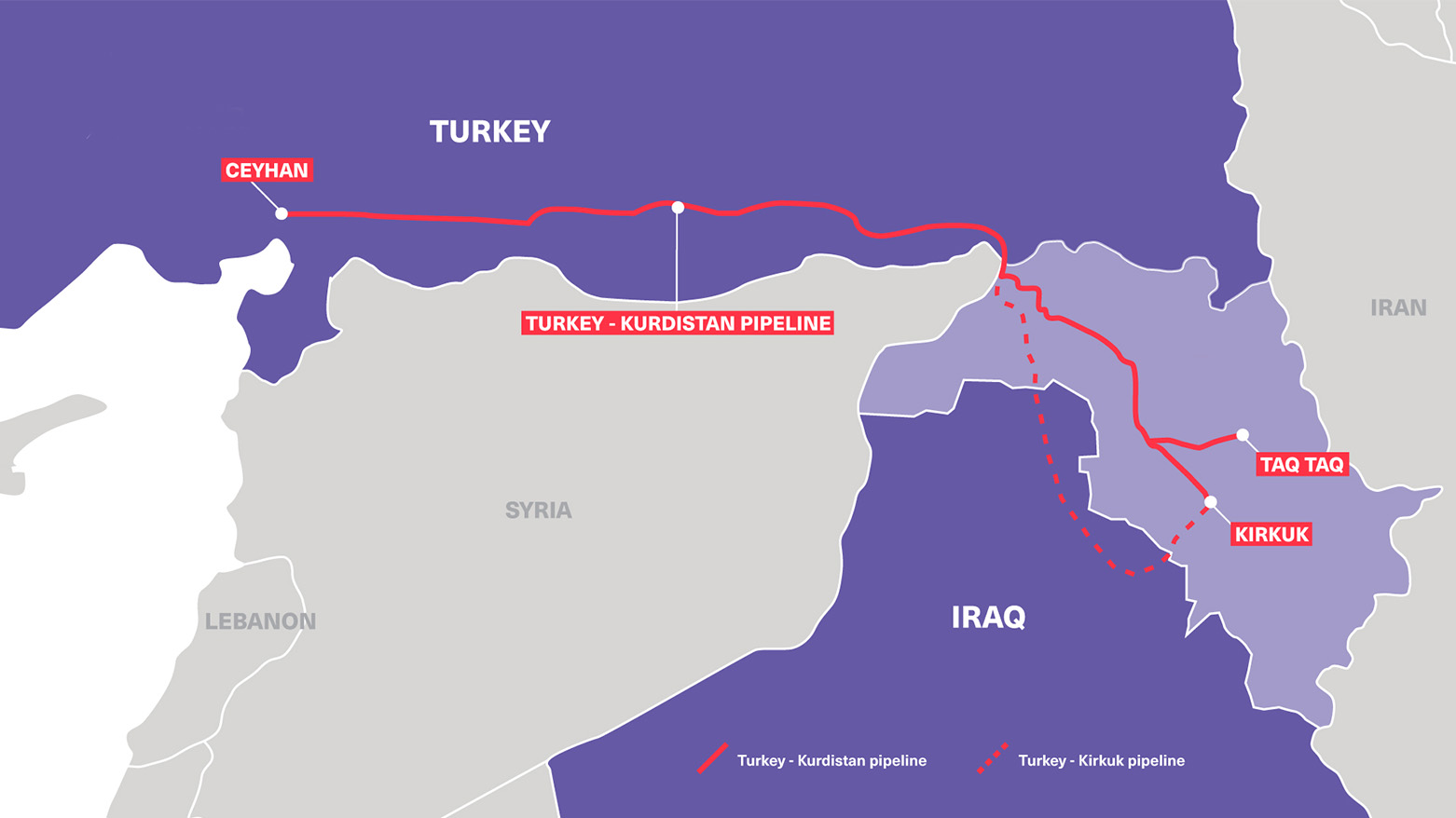
Iraqi cabinet Tuesday approved a plan to ramp up exports through the pipeline, which extends from the Kurdistan and Kirkuk fields to Turkey's Mediterranean port of Ceyhan, from 220,000 to 770,000 barrels per day within two and a half months. The margin anatomy reveals immediate commercial consequences: at current Brent crude futures around $98 per barrel and Mediterranean delivery premiums of $2–3/barrel over Gulf pricing, Iraq's pipeline expansion captures roughly $150 million monthly in additional transit value. A worked example: 550,000 bpd of incremental pipeline capacity at $2.50/barrel premium equals $1.375 million daily or $41.25 million monthly in margin concentration. This accumulates to Mediterranean storage operators, Turkish transit authorities, and pipeline infrastructure holders not the crude seller.
Mediterranean crude traders gain immediate arbitrage access while Persian Gulf logistics providers lose 1.19 million bpd of cargo flows permanently. The Strait of Hormuz has been largely blocked by Iran since 28 February 2026, when the United States and Israel launched an air war against Iran, removing approximately 12–13 million barrels per day from global supply. Iraq's northern route shift represents 10% recovery of lost Hormuz capacity. On the buy side: European refineries gain direct Mediterranean access to Iraqi crude grades without Suez transit or Cape routing premiums. On the sell side: Iraq recaptures export capacity but absorbs pipeline tariffs of approximately $4–6/barrel versus pre-crisis Gulf shipping costs of $1.50–2.00/barrel. For intermediaries: freight operators securing Mediterranean to Europe routes now handle Iraqi heavy crude requiring specialized refining capacity.
Large integrated traders (Vitol, Trafigura, national oil company trading arms) can hedge delivery location risk through Dated Brent swaps and Mediterranean freight derivatives, limiting exposure to pipeline operational disruptions or Turkish transit policy changes. Smaller regional operators independent European refineries, Mediterranean fuel distributors, North African energy companies lack derivatives access and must secure Iraqi crude through bilateral term contracts with Turkish pipeline guarantees. The financing structure concentrates risk: pipeline capacity payments flow upfront while crude delivery occurs 45–60 days later, creating working capital requirements smaller operators cannot easily manage. Most regional players diversify by contracting both pipeline and traditional seaborne volumes, accepting higher blended costs for supply security.
The Iraq-Turkey pipeline has been repeatedly shut over Kurdish revenue disputes and PKK security incidents. The Iraq-Turkey pipeline, a major energy artery connecting the Kurdistan region's oilfields to Turkey, has been largely idle for more than a decade owing to damage caused by ISIS, as well as other armed groups. No timeline addresses how Iraq resolves the $25 billion debt dispute with Turkey or secures Kurdistan Regional Government cooperation for Kirkuk crude access. The pipeline's design capacity theoretically supports 1 million bpd, but achieving 770,000 bpd requires infrastructure investments not yet funded. A VLCC carrying 2 million barrels from Basra to Rotterdam earned approximately $28/MT at current rates around $18 million per voyage. The same cargo routed through Ceyhan pipeline pays $8–10 million in transit fees but avoids 25 day tanker voyages and Suez Canal tariffs of $800,000–900,000 per transit.
Freight concentration shifts decisively to Turkish transit operators and Mediterranean storage providers. Iraq plans to sign an agreement with Syria to transport, store and handle shipments of Basrah Light, Basrah Medium and Basrah Heavy crude through the Mediterranean ports of Baniyas and Tartous. Turkish pipeline capacity holders earn $4–6/barrel on 770,000 bpd throughput approximately $115–175 million monthly in transit revenue. Syrian port storage operators capture handling fees of $0.50–0.75/barrel on 420,000 bpd truck deliveries, generating $6.3–9.5 million monthly. Persian Gulf VLCC operators lose 1.19 million bpd equivalent cargo roughly 18 VLCC voyages monthly at current tanker availability. This freight margin transfer is permanent until Hormuz reopens and Iraq reverts to southern export routes.
Financing complexity emerges in the structured trade finance supporting this route shift. Pipeline capacity requires advance booking with Turkish authorities, creating 60–90 day payment obligations before crude delivery. Kurdish Regional Government cooperation demands revenue sharing agreements that complicate cargo title transfer. Syria route requires sanctions compliance verification for each truck convoy, adding legal costs and delivery delays. Letters of credit (LC) bank guarantees that payment will be made once shipping documents are presented must now accommodate pipeline delivery rather than bill of lading structures. Mediterranean refineries typically operate on 30 day payment terms, but pipeline pre-booking extends working capital cycles to 90–120 days. Smaller traders cannot finance this gap without credit facilities that larger integrated operators secure more easily.
Supply chain grounding reveals the physical complexity underlying these margin shifts. Crude oil from Iraq's southern Basra fields is trucked 400 miles north to Kirkuk's K1 storage facility, where it blends with local Kirkuk crude before entering the pipeline system. An official at Iraq's North Oil Company explained that around 400 tanker trucks transport crude daily from the Zubair station in Basra province to the K1 station in Kirkuk. The crude is then unloaded through 28 receiving points at the North Oil Company facility before being pumped through pipelines linking the K1 station to the Sarlu pumping station and onward through the Kurdistan Region's network to the Turkish Mediterranean port of Ceyhan. The 960 kilometer pipeline transits Kurdistan Regional Government territory, requiring Kurdish cooperation and revenue sharing that Iraq has not secured since 2017. Each truck convoy to Syria crosses active conflict zones where insurance costs exceed $200,000 per monthly coverage.
Historical precedent suggests Iraq's pipeline strategy faces systematic execution risk. The last major Hormuz disruption occurred during the 1980–1988 Iran-Iraq War, when alternative routing through Turkey and Saudi Arabia never achieved planned capacity due to geopolitical complications. Iraq's current plan assumes Kurdish cooperation that requires resolving oil revenue disputes dating to 2014, Turkish agreement to expand pipeline capacity without debt settlement, and Syrian port operations despite ongoing civil conflict. During the 1990s, Iraqi attempts to bypass Gulf shipping through Jordan and Turkey consistently underperformed targets by 40–60% due to infrastructure constraints and political disagreements. The 2.5 month timeline to triple pipeline capacity assumes equipment availability and engineering execution that previous regional projects have rarely achieved on schedule.
Market structure implications concentrate in the Brent-Dubai spread the price difference between North Sea crude and Middle East crude which determines whether Atlantic Basin oil can economically reach Asian refineries. Iraq's shift from Persian Gulf to Mediterranean delivery tightens Dubai crude availability while increasing Brent-linked supply. This strengthens the Dubai benchmark relative to Brent, compressing the spread from current levels around $3–4/barrel toward $1–2/barrel. Asian refineries structured for Middle East crude imports face higher costs accessing Iraqi barrels now flowing to European markets. Backwardation where near-term prices exceed forward prices in Iraqi crude markets signals buyers need physical supply immediately, but pipeline constraints limit spot market flexibility that tanker deliveries traditionally provided.
Watch Turkish pipeline utilization data from BOTAŞ (published monthly with 45-day lag) and Kurdistan Regional Government oil revenue statements (quarterly). If Iraq achieves 500,000+ bpd through Ceyhan by September 2026, the route becomes structurally viable. Below 400,000 bpd indicates infrastructure or political constraints that will force Iraq back to Hormuz dependence when the strait reopens. Syrian truck convoy counts (reported weekly by Iraqi Oil Ministry) provide early warning of logistics breakdown sustained flows below 300,000 bpd suggest security or customs complications that undermine the overland strategy.
.jpg)

'%3e%3cg id='Final-Copy-2_2_' transform='translate(1275.000000, 200.000000)'%3e%3cpath class='st0' d='M7.4,12.8h6.8l3.1-11.6H7.4C4.2,1.2,1.6,3.8,1.6,7S4.2,12.8,7.4,12.8z'/%3e%3c/g%3e%3c/g%3e%3c/g%3e%3cg id='final---dec.11-2020'%3e%3cg id='_x30_208-our-toggle' transform='translate(-1275.000000, -200.000000)'%3e%3cg id='Final-Copy-2' transform='translate(1275.000000, 200.000000)'%3e%3cpath class='st1' d='M22.6,0H7.4c-3.9,0-7,3.1-7,7s3.1,7,7,7h15.2c3.9,0,7-3.1,7-7S26.4,0,22.6,0z M1.6,7c0-3.2,2.6-5.8,5.8-5.8 h9.9l-3.1,11.6H7.4C4.2,12.8,1.6,10.2,1.6,7z'/%3e%3cpath id='x' class='st2' d='M24.6,4c0.2,0.2,0.2,0.6,0,0.8l0,0L22.5,7l2.2,2.2c0.2,0.2,0.2,0.6,0,0.8c-0.2,0.2-0.6,0.2-0.8,0 l0,0l-2.2-2.2L19.5,10c-0.2,0.2-0.6,0.2-0.8,0c-0.2-0.2-0.2-0.6,0-0.8l0,0L20.8,7l-2.2-2.2c-0.2-0.2-0.2-0.6,0-0.8 c0.2-0.2,0.6-0.2,0.8,0l0,0l2.2,2.2L23.8,4C24,3.8,24.4,3.8,24.6,4z'/%3e%3cpath id='y' class='st3' d='M12.7,4.1c0.2,0.2,0.3,0.6,0.1,0.8l0,0L8.6,9.8C8.5,9.9,8.4,10,8.3,10c-0.2,0.1-0.5,0.1-0.7-0.1l0,0 L5.4,7.7c-0.2-0.2-0.2-0.6,0-0.8c0.2-0.2,0.6-0.2,0.8,0l0,0L8,8.6l3.8-4.5C12,3.9,12.4,3.9,12.7,4.1z'/%3e%3c/g%3e%3c/g%3e%3c/g%3e%3c/g%3e%3c/svg%3e) Privacy Choices
Privacy Choices