.avif)
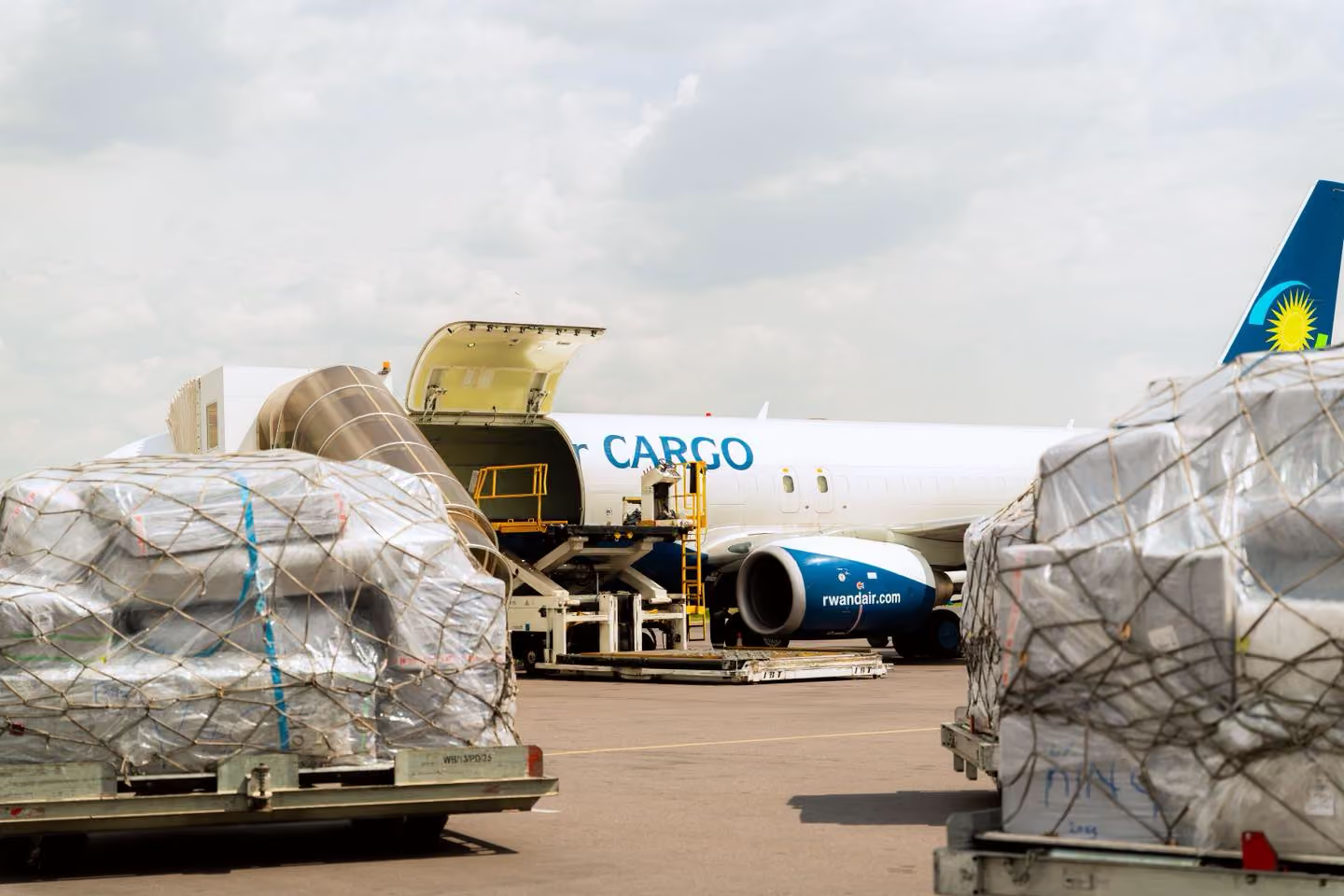
Nigerian agricultural exporters face dramatically reduced logistics costs on new air cargo routes to East Africa, but the under $2 per kilogram freight rates require subsidies that may not last beyond June 2026s inaugural phase.
Nigerias expanded partnership with RwandAir extends its existing air cargo corridor to connect Lagos with Kigali, Lusaka, and Harare, offering rates below $2 per kilogram for all five destinations compared to the previous $3-10 per kilogram that made African trade prohibitive for most goods. The corridor targets exporters in agribusiness, fashion and textiles, cosmetics, light manufacturing, and processed foods, but air freight economics favour high-value, low-weight cargo that agricultural and textile products typically do not represent unless heavily processed.
An air freight corridor a pre-negotiated route with fixed pricing and dedicated cargo capacity between specific airports differs fundamentally from ocean freight in its economics. African air freight rates have surged 62% year on year to $2.95 per kilogram, driven by jet fuel costs climbing to $171 per barrel, more than double January levels. Consider a mid-sized Nigerian sesame seed exporter shipping a 5 tonne cargo to Harare. At the new $2/kg rate, air freight costs $10,000 per shipment. Before the corridor, the same cargo faced $15,000-50,000 in air freight costs or $2,000-3,000 via ocean freight with 30-45 day transit times. The question becomes whether the 7-10 day air transit advantage justifies the 3-5x cost premium over maritime alternatives for price-sensitive agricultural commodities.
On the buy side: Small and medium agricultural exporters cassava flour processors, dried fish suppliers, spice traders gain access to regional markets previously blocked by prohibitive logistics costs. A Lagos-based palm oil derivatives company shipping 2 tonnes monthly to Rwanda now pays $4,000 per shipment instead of $6,000-20,000, creating a viable export margin for processed foods where none existed. On the sell side: RwandAir expands its cargo revenue base while Nigerian freight forwarders capture margin on consolidation and customs clearance services. Nigerias non-oil exports to Africa rose from $150 million in 2024 to $207 million in 2025, indicating early success, but growth must accelerate significantly to justify continued subsidies.
For larger integrated traders with commodity financing capabilities: The corridor provides a hedging instrument against ocean freight volatility and port congestion, particularly for time-sensitive agricultural products like fresh herbs or specialty grains. A commodity trading house can secure air freight capacity at fixed rates, removing logistics uncertainty from pricing calculations. For smaller regional operators without derivatives access: The bilateral rate agreements function as practical protection against freight rate spikes essentially a government-backed freight insurance policy.
The corridors sustainability depends on volume growth justifying reduced per-unit subsidies. RwandAirs under $2 rate represents up to 70% discounts versus commercial carriers, suggesting government absorption of $1.50-2.50 per kilogram in freight costs. Monitor the June 2026 formal launch for actual cargo volumes versus projected capacity utilization. If monthly tonnage fails to reach 1,000-1,500 tonnes across all five routes by August 2026, the rate structure will require recalibration or risk program suspension.
.jpg)



'%3e%3cg id='Final-Copy-2_2_' transform='translate(1275.000000, 200.000000)'%3e%3cpath class='st0' d='M7.4,12.8h6.8l3.1-11.6H7.4C4.2,1.2,1.6,3.8,1.6,7S4.2,12.8,7.4,12.8z'/%3e%3c/g%3e%3c/g%3e%3c/g%3e%3cg id='final---dec.11-2020'%3e%3cg id='_x30_208-our-toggle' transform='translate(-1275.000000, -200.000000)'%3e%3cg id='Final-Copy-2' transform='translate(1275.000000, 200.000000)'%3e%3cpath class='st1' d='M22.6,0H7.4c-3.9,0-7,3.1-7,7s3.1,7,7,7h15.2c3.9,0,7-3.1,7-7S26.4,0,22.6,0z M1.6,7c0-3.2,2.6-5.8,5.8-5.8 h9.9l-3.1,11.6H7.4C4.2,12.8,1.6,10.2,1.6,7z'/%3e%3cpath id='x' class='st2' d='M24.6,4c0.2,0.2,0.2,0.6,0,0.8l0,0L22.5,7l2.2,2.2c0.2,0.2,0.2,0.6,0,0.8c-0.2,0.2-0.6,0.2-0.8,0 l0,0l-2.2-2.2L19.5,10c-0.2,0.2-0.6,0.2-0.8,0c-0.2-0.2-0.2-0.6,0-0.8l0,0L20.8,7l-2.2-2.2c-0.2-0.2-0.2-0.6,0-0.8 c0.2-0.2,0.6-0.2,0.8,0l0,0l2.2,2.2L23.8,4C24,3.8,24.4,3.8,24.6,4z'/%3e%3cpath id='y' class='st3' d='M12.7,4.1c0.2,0.2,0.3,0.6,0.1,0.8l0,0L8.6,9.8C8.5,9.9,8.4,10,8.3,10c-0.2,0.1-0.5,0.1-0.7-0.1l0,0 L5.4,7.7c-0.2-0.2-0.2-0.6,0-0.8c0.2-0.2,0.6-0.2,0.8,0l0,0L8,8.6l3.8-4.5C12,3.9,12.4,3.9,12.7,4.1z'/%3e%3c/g%3e%3c/g%3e%3c/g%3e%3c/g%3e%3c/svg%3e) Privacy Choices
Privacy Choices