.avif)
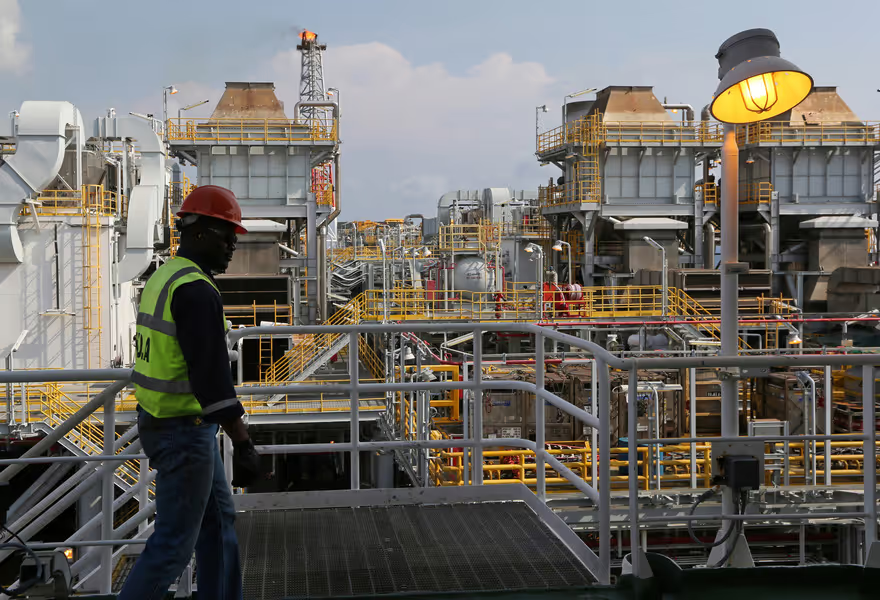
Nigerian Upstream Producers face unchanged operational risks despite the Nigerian Upstream Petroleum Regulatory Commission (NUPRC) board's resumption on April 28, 2026, as regulatory efficiency improvements cannot address core investment deterrents: security threats, infrastructure gaps, and systemic delays that have persisted through multiple leadership changes. The newly inaugurated board, led by Chairman Magnus Abe, pledged to strengthen the regulator's capacity and provide better leadership and oversight. Chief Executive Oritsemeyiwa Eyesan described the timing as crucial amid global oil market volatility from Middle East conflicts and the energy transition. The NUPRC Nigeria's upstream petroleum regulator responsible for licensing, compliance monitoring, and resource development oversight operates under the 2021 Petroleum Industry Act but cannot control the operational environment that determines project economics.
A regulatory efficiency board cannot solve Nigeria's fundamental upstream investment obstacles. Consider a mid-sized international operator evaluating a $500 million deepwater development: security costs alone add $15-25 million annually through vessel protection, pipeline surveillance, and facility hardening expenses that persist regardless of regulatory leadership. Infrastructure deficits compound costs: inadequate power supply forces operators to install dedicated generation at $50-100 million per major facility, while poor road networks increase logistics costs by 30-40% versus comparable West African locations. Bureaucratic delays obtaining permits, resolving land disputes, securing environmental clearances stretch project timelines 12-18 months beyond regional benchmarks. Abe himself acknowledged infrastructure challenges, stating that "getting proper office accommodation should take priority over everything else" revealing that even the regulator faces basic infrastructure constraints.
On the buy side: Large integrated operators (Chevron, TotalEnergies, ExxonMobil) with existing Nigerian exposure can absorb regulatory uncertainty through portfolio diversification and hedging instruments, but new entrants face 18-24 month due diligence cycles before committing capital. Mid-sized independents seeking Nigerian assets must price additional risk premiums of 200-300 basis points above comparable African opportunities, often making projects uneconomical at current oil prices. Regional operators and local companies benefit from regulatory streamlining but lack the technical capacity and capital depth to develop complex offshore assets that drive Nigeria's production growth. Indigenous operators now contribute approximately 200,000 bpd to national output following international oil company divestments, but this represents asset transfers rather than new investment.
On the sell side: Nigeria approved 28 field development plans worth $18.2 billion in 2025, targeting 1.4 billion barrels of recoverable reserves, demonstrating project availability. However, sellers face compressed margins as buyers demand steeper discounts to offset operational risks Nigerian crude often trades at $2-4/barrel discount to Brent versus historical parity. Production has rebounded to 1.6-1.7 million barrels per day by April 2026, but this represents recovery from artificially depressed levels rather than sustained growth. For traders and intermediaries: margin opportunities concentrate in short-term arbitrage rather than long-term partnerships, as regulatory stability remains unproven despite board changes. The Middle East supply disruption creating what the IEA called the largest supply shock on record temporarily masks Nigeria's competitiveness challenges.
The NUPRC board's infrastructure focus highlights systemic constraints beyond regulatory scope. Nigeria's upstream sector requires $30-40 billion in roads, power generation, and port facilities before regulatory efficiency translates to investment flows investments that exceed the regulator's authority and span multiple government agencies. ExxonMobil's $1.5 billion deepwater commitment between Q2 2025-2027 represents existing relationships rather than new board-driven confidence.
For observers: Monitor the NUPRC's quarterly licensing round participation rates over the next 12 months if applications remain concentrated among existing operators rather than new entrants, it confirms that regulatory leadership changes alone cannot overcome Nigeria's investment obstacles. Track indigenous operator production contributions through Q3 2026: sustained growth above 250,000 bpd would signal genuine sector improvement versus temporary recovery effects.


.jpg)
.jpg)

'%3e%3cg id='Final-Copy-2_2_' transform='translate(1275.000000, 200.000000)'%3e%3cpath class='st0' d='M7.4,12.8h6.8l3.1-11.6H7.4C4.2,1.2,1.6,3.8,1.6,7S4.2,12.8,7.4,12.8z'/%3e%3c/g%3e%3c/g%3e%3c/g%3e%3cg id='final---dec.11-2020'%3e%3cg id='_x30_208-our-toggle' transform='translate(-1275.000000, -200.000000)'%3e%3cg id='Final-Copy-2' transform='translate(1275.000000, 200.000000)'%3e%3cpath class='st1' d='M22.6,0H7.4c-3.9,0-7,3.1-7,7s3.1,7,7,7h15.2c3.9,0,7-3.1,7-7S26.4,0,22.6,0z M1.6,7c0-3.2,2.6-5.8,5.8-5.8 h9.9l-3.1,11.6H7.4C4.2,12.8,1.6,10.2,1.6,7z'/%3e%3cpath id='x' class='st2' d='M24.6,4c0.2,0.2,0.2,0.6,0,0.8l0,0L22.5,7l2.2,2.2c0.2,0.2,0.2,0.6,0,0.8c-0.2,0.2-0.6,0.2-0.8,0 l0,0l-2.2-2.2L19.5,10c-0.2,0.2-0.6,0.2-0.8,0c-0.2-0.2-0.2-0.6,0-0.8l0,0L20.8,7l-2.2-2.2c-0.2-0.2-0.2-0.6,0-0.8 c0.2-0.2,0.6-0.2,0.8,0l0,0l2.2,2.2L23.8,4C24,3.8,24.4,3.8,24.6,4z'/%3e%3cpath id='y' class='st3' d='M12.7,4.1c0.2,0.2,0.3,0.6,0.1,0.8l0,0L8.6,9.8C8.5,9.9,8.4,10,8.3,10c-0.2,0.1-0.5,0.1-0.7-0.1l0,0 L5.4,7.7c-0.2-0.2-0.2-0.6,0-0.8c0.2-0.2,0.6-0.2,0.8,0l0,0L8,8.6l3.8-4.5C12,3.9,12.4,3.9,12.7,4.1z'/%3e%3c/g%3e%3c/g%3e%3c/g%3e%3c/g%3e%3c/svg%3e) Privacy Choices
Privacy Choices