.avif)
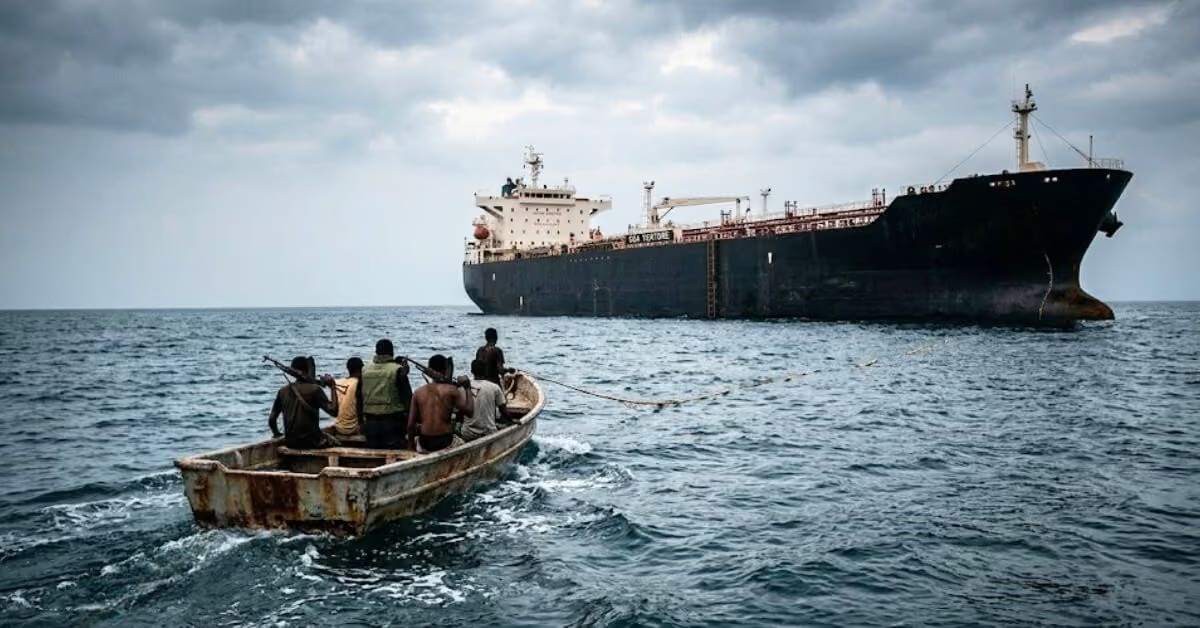
Product Tanker Owners face war risk insurance adjustments for East African routing following the April 21 hijacking of the Palau flagged MT Honour 25 off Somalia's Puntland region. Pirates initially demanded a $10 million ransom, later reducing it to $4 million, while 10 Pakistani sailors remain among the 17 member crew held hostage. War risk insurers the Lloyd's of London syndicates that price political and piracy coverage separately from hull and machinery policies began adjusting East African transit premiums within days of confirmation. A typical product tanker covering the 2,500 nautical mile route from Fujairah to Mombasa now faces war risk premiums of approximately $0.15-0.25 per $100 of vessel value, up from the $0.05-0.10 range that prevailed when Somalia was considered pacified.
Piracy the seizure of commercial vessels by armed groups demanding ransom payments had been effectively suppressed in Somali waters since 2012 through coordinated naval patrols. The Horn Review reports piracy is "reemerging in 2026 as a growing maritime security concern" with "early indicators of renewed activity visible along key shipping routes". The operational pattern shows sophistication: MT Honour 25 carried 17 crew members and around 18,500 barrels of oil, and was "anchored near the Puntland coast between Xaafun and Bander Beyla" after seizure. Brent crude prices "have risen by more than 50 percent since the start of the war, now trading above $110 per barrel, making fuel tankers like the Honour 25 more valuable targets". The economics are stark: at $110/barrel, 18,500 barrels represents roughly $2 million in cargo value sufficient to justify sustained criminal operations.
On the buy side, regional fuel importers in East Africa face a choice between accepting higher war risk costs or extending supply chains through alternative routing. A mid-sized Kenyan petroleum distributor importing 30,000 tonnes monthly via product tanker now confronts an additional $15,000-25,000 per cargo in war risk premiums costs that flow directly to pump prices in markets already strained by global energy inflation. On the sell side, product tanker operators find themselves caught between charter party clauses that allow for war risk surcharges and charterers' resistance to cost increases. The Baltic Clean Tanker Index (BCTI) which tracks clean petroleum product freight rates has not yet reflected piracy premiums, suggesting the additional costs remain within war risk insurance rather than base freight.
For large integrated traders with derivatives access the Trafiguras and Vitols managing global product flows the response involves futures market hedging of the war risk premium itself, treating piracy exposure as another risk factor to be monetised through options strategies. These operators can absorb temporary premium spikes while positioning for volatility trades around East African routing. For smaller regional operators independent fuel importers, coastal distributors, national petroleum marketing companies without sophisticated risk management the practical equivalent involves bilateral contract amendments with suppliers to share war risk costs, or inventory adjustments that reduce exposure to piracy prone routes. Mid-sized operators face the sharpest margin pressure: large enough to require East African supply access, too small to hedge the associated risks efficiently.
For observers tracking this development, the United Kingdom Maritime Trade Operations (UKMTO) "raised the threat levels around the Somalia coast to 'substantial' this week" represents the key forward signal. UKMTO threat level changes typically precede Lloyd's war risk committee adjustments by 7-14 days, providing advance notice for charter market positioning. The specific indicator to monitor: whether EUNAVFOR Operation Atalanta the EU's anti-piracy naval mission requests additional frigate deployments to East African waters by month-end. Somali piracy "had significantly declined between 2018 and 2024 as a result of international naval interventions", but naval resources have been diverted elsewhere. Any formal naval reinforcement request confirms that war risk premiums will persist above pre-piracy levels through Q3 2026, establishing a new baseline for product tanker economics on this critical supply route.


.jpg)

'%3e%3cg id='Final-Copy-2_2_' transform='translate(1275.000000, 200.000000)'%3e%3cpath class='st0' d='M7.4,12.8h6.8l3.1-11.6H7.4C4.2,1.2,1.6,3.8,1.6,7S4.2,12.8,7.4,12.8z'/%3e%3c/g%3e%3c/g%3e%3c/g%3e%3cg id='final---dec.11-2020'%3e%3cg id='_x30_208-our-toggle' transform='translate(-1275.000000, -200.000000)'%3e%3cg id='Final-Copy-2' transform='translate(1275.000000, 200.000000)'%3e%3cpath class='st1' d='M22.6,0H7.4c-3.9,0-7,3.1-7,7s3.1,7,7,7h15.2c3.9,0,7-3.1,7-7S26.4,0,22.6,0z M1.6,7c0-3.2,2.6-5.8,5.8-5.8 h9.9l-3.1,11.6H7.4C4.2,12.8,1.6,10.2,1.6,7z'/%3e%3cpath id='x' class='st2' d='M24.6,4c0.2,0.2,0.2,0.6,0,0.8l0,0L22.5,7l2.2,2.2c0.2,0.2,0.2,0.6,0,0.8c-0.2,0.2-0.6,0.2-0.8,0 l0,0l-2.2-2.2L19.5,10c-0.2,0.2-0.6,0.2-0.8,0c-0.2-0.2-0.2-0.6,0-0.8l0,0L20.8,7l-2.2-2.2c-0.2-0.2-0.2-0.6,0-0.8 c0.2-0.2,0.6-0.2,0.8,0l0,0l2.2,2.2L23.8,4C24,3.8,24.4,3.8,24.6,4z'/%3e%3cpath id='y' class='st3' d='M12.7,4.1c0.2,0.2,0.3,0.6,0.1,0.8l0,0L8.6,9.8C8.5,9.9,8.4,10,8.3,10c-0.2,0.1-0.5,0.1-0.7-0.1l0,0 L5.4,7.7c-0.2-0.2-0.2-0.6,0-0.8c0.2-0.2,0.6-0.2,0.8,0l0,0L8,8.6l3.8-4.5C12,3.9,12.4,3.9,12.7,4.1z'/%3e%3c/g%3e%3c/g%3e%3c/g%3e%3c/g%3e%3c/svg%3e) Privacy Choices
Privacy Choices