.avif)
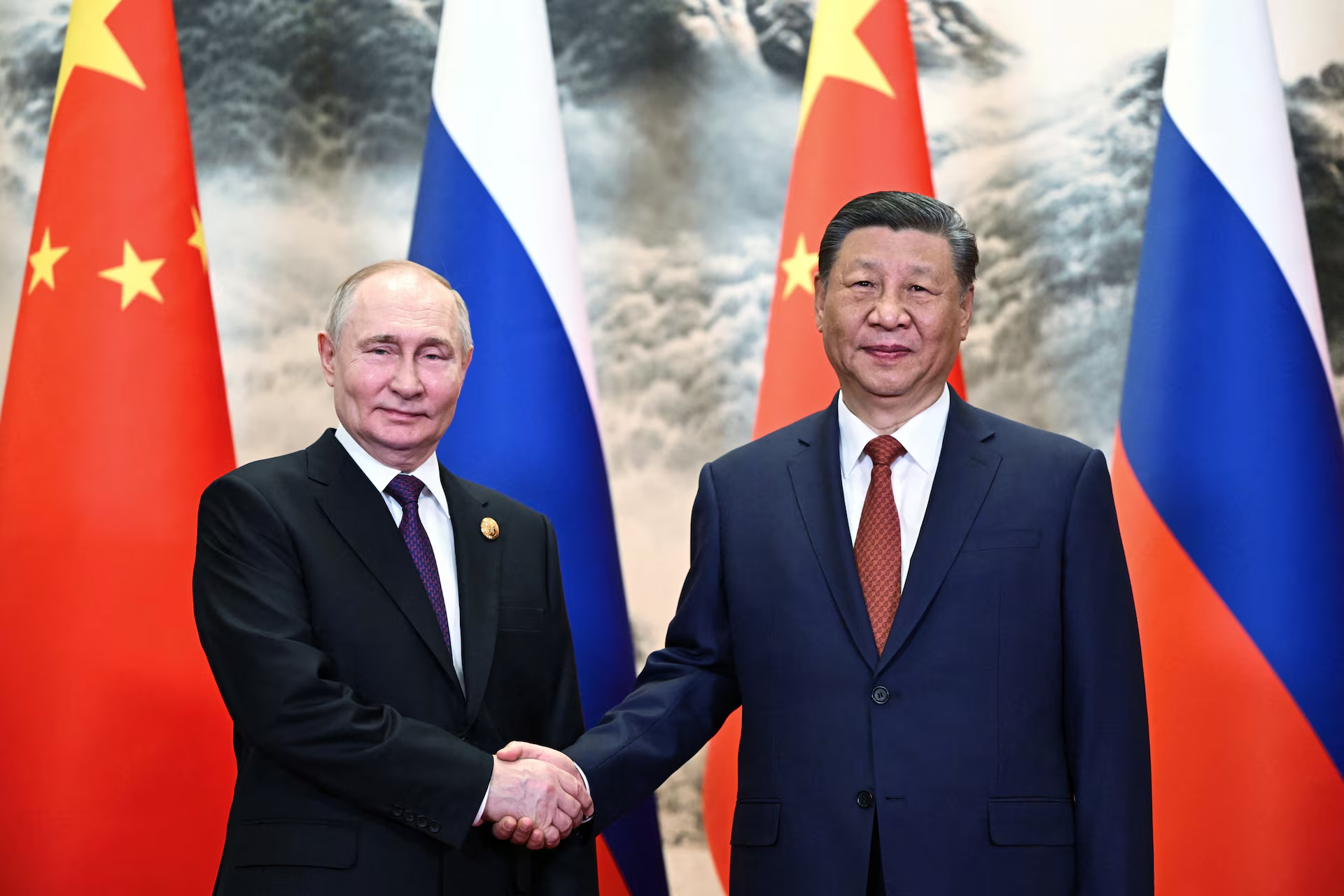
Chinese gas utilities importing a third of their LNG through the now-closed Strait of Hormuz face immediate supply shortfalls that Putin and Xi's pipeline agreement cannot address. Asian spot LNG prices (JKM) the benchmark for Northeast Asian gas procurement traded at $18/MMBtu in early May, up from $17/MMBtu weeks earlier. The Power of Siberia 2 project discussed in Beijing would carry 50 billion cubic meters annually from Russia's Yamal fields to China via Mongolia but the pipeline "may take a decade from start of construction to full capacity," according to energy analysts. A letter of credit (LC) a bank guarantee that payment will be made once shipping documents are presented remains the instrument financing immediate LNG spot purchases at current elevated prices. While Russia and China "reached an understanding on the project's main parameters," key details including "pricing, financing terms, and a delivery timeline remain unresolved".
Power of Siberia 2 a proposed 2,600-kilometer natural gas pipeline designed to transport Russian gas from western Siberian fields through Mongolia to northern China faces a fundamental timing mismatch with China's energy needs. Experts note that "it is impossible to estimate the project's cost since no construction plan has been approved, no contracts have been signed, and the exact route remains undetermined". Cost estimates range from $13.6 billion to $34 billion, with the total project cost expected to reach "up to US$14 billion" for a 30 billion cubic meter capacity version. Consider a mid-sized Chinese municipal gas utility serving 5 million residents: at current JKM prices of $18/MMBtu, importing 2 billion cubic meters annually costs approximately $1.3 billion. The same volume through a future Russian pipeline priced at domestic rates would cost roughly $240–260 million annually a $1 billion annual saving that remains theoretical until the 2030s. Construction could span "4 to 5 years" based on Power of Siberia 1 timelines, which "was carried out from 2014 to 2019".
On the buy side: Chinese gas utilities must secure immediate replacement volumes for approximately 10 billion cubic feet per day of global LNG supplies disrupted by Strait of Hormuz closure, forcing them into spot markets where JKM prices have surged 51% to over $16/MMBtu. Large integrated utilities like Beijing Gas Group or China Resources Gas can hedge through futures contracts, but pricing reflects current supply tightness not pipeline promises. Mid-sized regional distributors lack derivatives access and must fix bilateral supply contracts at prevailing spot rates or adjust inventory management to weather the supply gap. China's LNG import capacity is expanding from 144 to 250 billion cubic meters annually between 2022 and 2027, but this infrastructure serves current needs, not future pipeline economics. On the sell side: Russian oil exports to China grew 35% in the first quarter of 2026, but gas remains pipeline dependent. Russia's gas exports to Europe collapsed from 157 billion cubic meters in 2021 to an expected 39 billion cubic meters in 2025, leaving Gazprom with a $6.8 billion net loss in 2023 the company's first annual loss since 1999. Russian pipeline gas pricing power in Chinese markets strengthens over a 10+ year horizon but provides no immediate revenue recovery.
The arithmetic of infrastructure timing reveals the gap between political symbolism and commercial reality. The first Power of Siberia pipeline "carries gas from two eastern Siberian fields to the Russia-China border" with "construction begun after a 2014 agreement," first deliveries starting "in 2019," reaching "full capacity in 2024" a decade-long development cycle. Power of Siberia 2's planned 2,600 kilometer route carrying 50 billion cubic meters annually crosses three jurisdictions (Russia, Mongolia, China), requiring separate environmental approvals, financing agreements, and technical specifications. The trans-Mongolian section alone could generate $1 billion annually in transit fees for Mongolia, creating additional stakeholder complexity. For large integrated traders (Sinopec, PetroChina, CNOOC) with derivatives access: JKM futures contracts extending to December 2027 currently trade at $14–15/MMBtu, suggesting markets expect structural supply tightness to persist well beyond any pipeline completion. The derivatives curve shows no pricing relief from Russian pipeline capacity additions until the 2030s. For regional Chinese gas distributors without futures access: bilateral supply contracts with Qatar, Australia, or U.S. LNG exporters at oil-indexed pricing formulas represent the practical equivalent of pipeline supply security, albeit at current elevated price levels.
Watch for specific signals indicating whether pipeline politics translates into construction reality. Monitor CNPC's quarterly capital expenditure allocation in earnings reports beginning Q3 2026 pipeline engineering and survey spending would appear as "exploration and development" capex before any ceremonial groundbreaking. Track Mongolia's parliament approval of transit agreements by December 2026; Mongolia "would be unlikely to object to collecting hundreds of millions of dollars a year in transit fees" but requires formal legislative ratification. Alexei Gromov of the Institute for Energy and Finance predicted "a proper contract for the Power of Siberia 2 could be signed later in 2025", making contract announcement by year-end the key milestone. JKM-Henry Hub spreads above $10/MMBtu currently around $15/MMBtu signal persistent Asian supply tightness that theoretical pipeline capacity cannot address in the near term. The China-Russia energy relationship represents a structural shift eastward, but infrastructure reality means Chinese utilities will pay elevated prices for LNG imports throughout the remainder of this decade.



'%3e%3cg id='Final-Copy-2_2_' transform='translate(1275.000000, 200.000000)'%3e%3cpath class='st0' d='M7.4,12.8h6.8l3.1-11.6H7.4C4.2,1.2,1.6,3.8,1.6,7S4.2,12.8,7.4,12.8z'/%3e%3c/g%3e%3c/g%3e%3c/g%3e%3cg id='final---dec.11-2020'%3e%3cg id='_x30_208-our-toggle' transform='translate(-1275.000000, -200.000000)'%3e%3cg id='Final-Copy-2' transform='translate(1275.000000, 200.000000)'%3e%3cpath class='st1' d='M22.6,0H7.4c-3.9,0-7,3.1-7,7s3.1,7,7,7h15.2c3.9,0,7-3.1,7-7S26.4,0,22.6,0z M1.6,7c0-3.2,2.6-5.8,5.8-5.8 h9.9l-3.1,11.6H7.4C4.2,12.8,1.6,10.2,1.6,7z'/%3e%3cpath id='x' class='st2' d='M24.6,4c0.2,0.2,0.2,0.6,0,0.8l0,0L22.5,7l2.2,2.2c0.2,0.2,0.2,0.6,0,0.8c-0.2,0.2-0.6,0.2-0.8,0 l0,0l-2.2-2.2L19.5,10c-0.2,0.2-0.6,0.2-0.8,0c-0.2-0.2-0.2-0.6,0-0.8l0,0L20.8,7l-2.2-2.2c-0.2-0.2-0.2-0.6,0-0.8 c0.2-0.2,0.6-0.2,0.8,0l0,0l2.2,2.2L23.8,4C24,3.8,24.4,3.8,24.6,4z'/%3e%3cpath id='y' class='st3' d='M12.7,4.1c0.2,0.2,0.3,0.6,0.1,0.8l0,0L8.6,9.8C8.5,9.9,8.4,10,8.3,10c-0.2,0.1-0.5,0.1-0.7-0.1l0,0 L5.4,7.7c-0.2-0.2-0.2-0.6,0-0.8c0.2-0.2,0.6-0.2,0.8,0l0,0L8,8.6l3.8-4.5C12,3.9,12.4,3.9,12.7,4.1z'/%3e%3c/g%3e%3c/g%3e%3c/g%3e%3c/g%3e%3c/svg%3e) Privacy Choices
Privacy Choices