.avif)
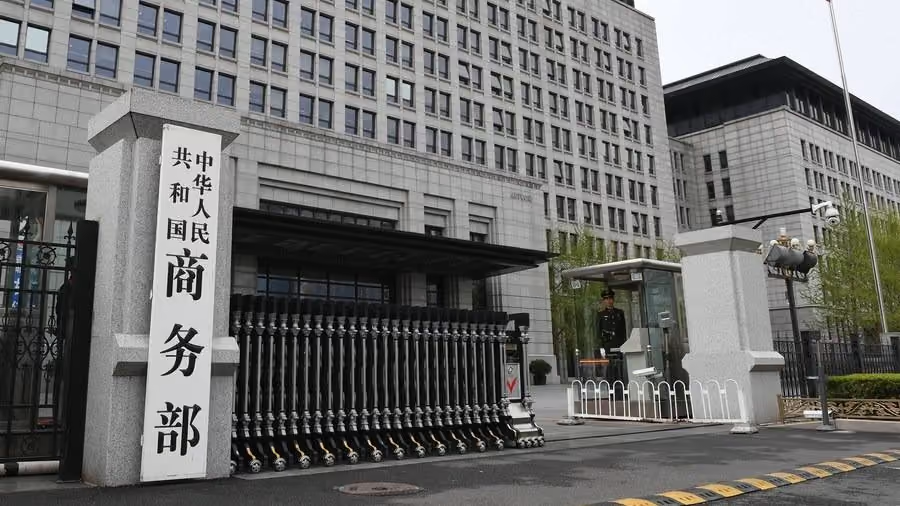
Australian beef exporters lost access to their most valuable protein export channel at midnight on June 19, 2026 when China's Ministry of Commerce (MOFCOM) triggered a 55% additional tariff on Australian beef, effective June 20, after shipments exhausted the 205,000 tonne country specific safeguard quota set for the year.
The safeguard mechanism a trade remedy tool that allows importing countries to impose extra duties when import volumes exceed a pre-agreed threshold was established under a MOFCOM investigation launched December 27, 2024. The resulting framework, formalised in MOFCOM's "No. 87" announcement of December 31, 2025, runs from January 1, 2026 through December 31, 2028, and assigns country specific quotas to all major beef exporting nations supplying China. The total 2026 quota across all covered suppliers is 2.69 million tonnes a figure that mirrors, almost exactly, China's entire 2024 beef import volume of 2.87 million tonnes. That calibration is not coincidental. The framework is structurally designed to cap, not accommodate, demand growth. Australia's 205,000 tonne allocation was always a ceiling, not a floor.
To understand what the 55% additional tariff means commercially, start with what Australian chilled and frozen beef cost a Chinese importer before June 20. Australian product entered China under the China-Australia Free Trade Agreement (ChAFTA) at preferential duty rates, meaning the effective import tariff was already low relative to suppliers without a trade agreement. Chinese importers were paying MFN (most favoured nation the standard tariff applied to all trading partners without a preferential agreement) rates of approximately 12–15% for competing origins. Now, Australian product carries those existing duties plus the additional 55% safeguard levy. The effective landed cost uplift for a Chinese importer buying Australian grass-fed frozen boneless beef typically priced at around $5,000–$5,500 per tonne CFR (cost and freight the price including shipping to the destination port) rises by approximately $2,750–$3,025 per tonne at the 55% rate applied to the CFR value. A container of 22 tonnes, previously viable at a landed cost of roughly $110,000–$121,000, now requires an additional $60,500–$66,550 just to clear customs. No Chinese importer absorbs that. The economics are closed, not compressed.
On the sell side, Australian beef processors and export licensed meatworks face an abrupt demand withdrawal from a channel that commanded meaningful premiums. China had been the destination for significant volumes of secondary cuts blade, chuck, shin that attract less demand in higher-income markets like Japan or South Korea, but found a ready market in China's growing food-service sector and hot-pot restaurant chains. The loss of that channel does not simply reroute product; it reprices it. Those cuts, displaced from China and redirected toward Southeast Asia Vietnam, Indonesia, the Philippines or the Middle East, will clear at lower values in markets with different quality preferences and thinner import budgets. The Australian Meat Industry Council's chief executive Tim Ryan confirmed "immediate impacts for Australian exporters," noting that "the combination of external trade barriers and rising domestic costs makes 2026 an exceptionally challenging year for the sector." The sell-side pressure is structural, not temporary, for as long as the safeguard runs.
For large, integrated beef trading firms those with multi-origin procurement desks, cold-chain logistics across multiple corridors, and access to financial hedging instruments the margin anatomy of this event concentrates in the origin substitution spread. As Australian supply exits the Chinese market through approximately mid-November 2026 (the horizon projected by analyst Matt Dalgleish), Chinese importers will bid up competing origins. US beef, shipped via Pacific lanes on reefer-fitted containers refrigerated containers maintaining a consistent temperature between -18°C and +2°C depending on product specification and New Zealand chilled product both carry intact or more available quota headroom under the same MOFCOM safeguard framework. A large trader long on US or New Zealand beef inventory, or with forward purchase contracts already in place, captures the price uplift directly. Estimated FOB (free on board the price at which the seller delivers goods onto the vessel, with the buyer assuming freight costs from that point) price uplift for competing origins is 5–15% if Chinese demand holds firm, per Expana projections.
The substitution narrative carries a structural risk that the current consensus underweights. MOFCOM reported on May 10 that Brazilian beef imports had already reached 50% of Brazil's annual safeguard quota by May 9 meaning Brazil, one of China's largest beef suppliers globally, was on track to exhaust its allocation well before year-end. If Brazil, Australia, and potentially Argentina hit their respective thresholds in sequence across H2 2026, Chinese importers face not a manageable origin switch but a simultaneous multi-supplier supply constraint. In that scenario, China's domestic beef prices currently projected by most analysts to remain unaffected come under significant upward pressure from import scarcity. For a smaller, regional Chinese importer without the infrastructure to rapidly switch procurement desks from Sydney to Omaha to Auckland, the practical consequence is simply less product available at any price. That is an outcome with inflationary consequences for Chinese consumers that the current dominant analyst view has not fully priced.
For smaller Australian exporters a regional meatworks supplying frozen manufacturing beef to a single Chinese distribution partner the options are narrower and the pain more concentrated. Renegotiating terms bilaterally with existing buyers to defer or cancel H2 shipments is the immediate priority, before product is loaded at port. Frozen beef destined for China but not yet shipped can potentially be redirected; product already in transit on the water during the June 20 trigger date faces the full tariff on arrival. Operators in this position should model their landed cost exposure against alternative destination pricing in Japan, South Korea, and the Gulf Cooperation Council (GCC) markets now, before making freight commitments. Forward freight agreements bilateral contracts locking in shipping costs for a future date are available on the Australia to Northeast Asia reefer corridor through specialist brokers, and fixing outward freight while the market is not yet fully repricing the rerouted volume is one of the few available cost levers.
There is a specific, time-bound arbitrage embedded in the reset structure that sophisticated traders have already begun to examine. The MOFCOM safeguard quota resets on January 1, 2027. Australian beef currently being discounted in forward markets as H2 export volumes fall can theoretically be contracted now for January 2027 delivery, when the 205,000 tonne quota clock restarts and the 55% additional tariff drops away. The holding cost across a six-month period for frozen product is not trivial: cold-storage in Australian export facilities runs approximately $15–20 per tonne per month, and financing a frozen inventory position adds interest cost on top. But if Australian FOB prices discount by $150–200 per tonne relative to competing origins over the same period which is plausible given the export displacement pressure the carry trade generates positive margin before freight. This is a position available primarily to large, well capitalised traders; a regional exporter holding unsold inventory for six months faces working capital constraints that make it non-viable without external financing.
The single most important monitoring signal for Australian Beef Exporters through the remainder of 2026 is the MOFCOM weekly import data release specifically, the running volume tallies for Brazil, New Zealand, and the United States against their respective safeguard quotas. MOFCOM gave a 90% of quota warning for Australia on June 2, eighteen days before the trigger. The same warning mechanism will apply to other suppliers. If Brazil's running total approaches 90% of its allocation before October visible through MOFCOM's General Administration of Customs (GAC) data, published monthly and reconcilable against the quota framework it signals that the multi-supplier constraint scenario is materialising, not just the Australia specific one. In that event, Chinese domestic beef prices will rise, Australian forward contracts for January delivery become significantly more valuable, and any exporter who has fixed supply and freight for H2/H1 2027 delivery holds a structurally advantaged position. Watch the GAC data. The next warning notice, when it comes for any covered supplier, is the signal that the consensus is wrong.
.jpg)
'%3e%3cg id='Final-Copy-2_2_' transform='translate(1275.000000, 200.000000)'%3e%3cpath class='st0' d='M7.4,12.8h6.8l3.1-11.6H7.4C4.2,1.2,1.6,3.8,1.6,7S4.2,12.8,7.4,12.8z'/%3e%3c/g%3e%3c/g%3e%3c/g%3e%3cg id='final---dec.11-2020'%3e%3cg id='_x30_208-our-toggle' transform='translate(-1275.000000, -200.000000)'%3e%3cg id='Final-Copy-2' transform='translate(1275.000000, 200.000000)'%3e%3cpath class='st1' d='M22.6,0H7.4c-3.9,0-7,3.1-7,7s3.1,7,7,7h15.2c3.9,0,7-3.1,7-7S26.4,0,22.6,0z M1.6,7c0-3.2,2.6-5.8,5.8-5.8 h9.9l-3.1,11.6H7.4C4.2,12.8,1.6,10.2,1.6,7z'/%3e%3cpath id='x' class='st2' d='M24.6,4c0.2,0.2,0.2,0.6,0,0.8l0,0L22.5,7l2.2,2.2c0.2,0.2,0.2,0.6,0,0.8c-0.2,0.2-0.6,0.2-0.8,0 l0,0l-2.2-2.2L19.5,10c-0.2,0.2-0.6,0.2-0.8,0c-0.2-0.2-0.2-0.6,0-0.8l0,0L20.8,7l-2.2-2.2c-0.2-0.2-0.2-0.6,0-0.8 c0.2-0.2,0.6-0.2,0.8,0l0,0l2.2,2.2L23.8,4C24,3.8,24.4,3.8,24.6,4z'/%3e%3cpath id='y' class='st3' d='M12.7,4.1c0.2,0.2,0.3,0.6,0.1,0.8l0,0L8.6,9.8C8.5,9.9,8.4,10,8.3,10c-0.2,0.1-0.5,0.1-0.7-0.1l0,0 L5.4,7.7c-0.2-0.2-0.2-0.6,0-0.8c0.2-0.2,0.6-0.2,0.8,0l0,0L8,8.6l3.8-4.5C12,3.9,12.4,3.9,12.7,4.1z'/%3e%3c/g%3e%3c/g%3e%3c/g%3e%3c/g%3e%3c/svg%3e) Privacy Choices
Privacy Choices