.avif)
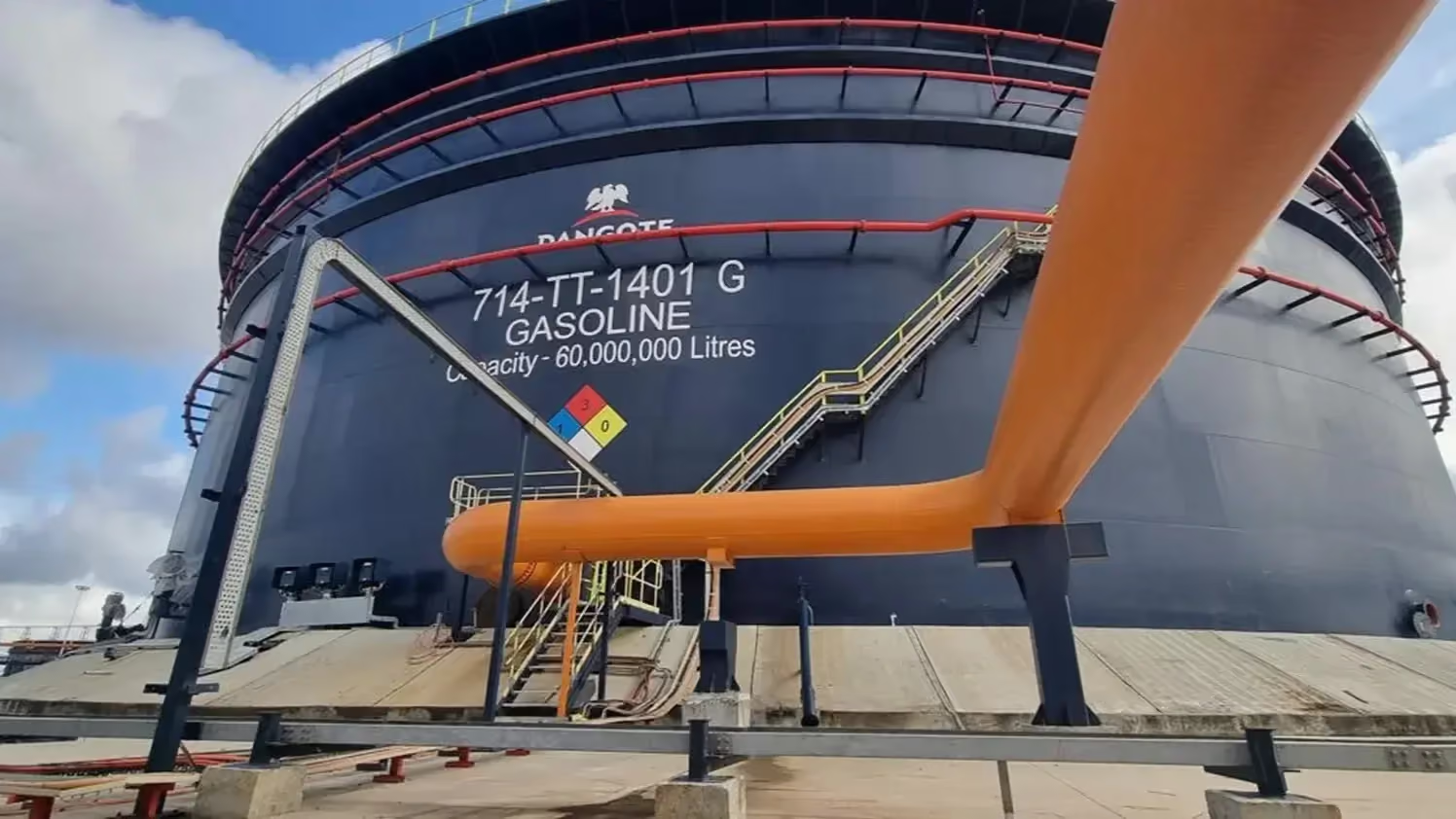
West African petroleum product traders carrying long import positions into the region face direct margin compression starting in Q3 2026, as Dangote Petroleum Refinery's decision to recall approximately 800 sanctioned engineers signals a deliberate push to restore full technical capacity at Africa's largest single-train refinery the only facility on the continent capable of producing refined products at a scale that can meaningfully displace seaborne imports.
The October 2025 disciplinary measures that triggered this episode remain opaque in one critical respect: the root cause. Dangote's internal memo, signed by Group Vice President for Oil and Gas Devakumar Edwin, describes the engineers as having been sanctioned following "internal operational disruptions," but that phrase covers an enormous range of scenarios from process safety failures and equipment mismanagement to industrial action or management disputes. Each scenario carries a different forward risk. A workforce that was disciplined for a coordinated work stoppage and then recalled under a conditional pardon is not the same as one returning from a technical process dispute. Management has framed the move as a balance between enforcing discipline and sustaining throughput, but the underlying tension is unresolved: the refinery dispersed its engineers across domestic Dangote subsidiaries and, according to reports, units outside Nigeria before concluding that dispersal itself was the greater operational threat.
The physical throughput stakes are substantial. Dangote's Lagos refinery has a nameplate capacity of 650,000 barrels per day single-train, meaning one integrated processing sequence rather than multiple parallel units, which concentrates both its efficiency advantage and its vulnerability. At full utilisation, the refinery can produce roughly 53 million litres of petrol per day alongside significant diesel and jet fuel volumes, enough to cover Nigeria's domestic fuel demand and export meaningfully into West Africa. In practice, utilisation since commissioning has been irregular. Consider a mid-sized West African trader who positioned three Aframax cargoes each carrying approximately 80,000 tonnes of diesel for Q3 2026 delivery from European refineries, priced against CIF West Africa (cost, insurance, and freight to West African ports) at an assumed landed cost of $720 per tonne. If Dangote's ex-refinery diesel price, currently estimated to track at a $15–25 per tonne discount to import parity, holds or widens as throughput recovers, that trader's $720 landed cargo competes against domestic supply at $695–705 per tonne. The margin that justified the position typically $8–12 per tonne is gone before port fees are calculated.
On the buy side, Nigerian fuel distributors and downstream retailers stand to benefit most directly. If Dangote throughput recovers materially in H2 2026, ex-refinery prices for petrol and diesel are likely to remain below import parity the landed cost of an equivalent imported cargo giving domestic buyers a structural cost advantage over competitors sourcing from the spot market. A large distribution company that can lock in offtake agreements now, before the market prices in full throughput recovery, captures that spread. On the sell side, the pressure falls on European and Asian refiners who have been running incremental volumes to West Africa as Dangote underperformed. Rotterdam-based complex refineries those capable of processing a wide range of crude inputs into high-specification products have been running diesel cracks (the margin between crude input cost and diesel output price) partly supported by West African demand. Any sustained Dangote recovery reduces that demand pull and softens the Atlantic Basin diesel crack, which as of late April 2026 was trading around $18–20 per barrel. A one percentage point drop in West African import demand does not move Rotterdam alone, but combined with other demand signals it narrows the margin window that has made European diesel exports viable.
For a large integrated trader a Vitol, Trafigura, or a national oil company's trading arm with access to paper derivatives markets the instrument here is a forward position in the Platts West Africa refined products assessments, combined with a derivatives hedge on European diesel crack spreads. The trade: unwind long import positions early, before the market consensus prices in Dangote's operational recovery, and simultaneously take a short position on the Atlantic Basin diesel crack. The window is narrow. If the recall is completed in May and engineers are back at stations by June, operational stabilisation signals should be visible in utilisation data by August. For a smaller regional operator a mid-sized fuel importer supplying Nigeria's northern corridors or a Ghanaian independent distributor derivatives access is unavailable. The practical equivalent is to shorten import contract durations now: shift from quarterly fixed-volume offtake agreements to monthly spot-indexed purchases, reducing exposure to the inventory devaluation that follows if Dangote supply floods the domestic market faster than the current consensus assumes.
The structural constraint beneath this episode is workforce depth. A refinery that can simultaneously redeploy 800 engineers to other business units and sustain some minimum operation during that period has revealed that those 800 are not truly surplus. If they were, the recall would be unnecessary. The bench is thin. Africa's pipeline of refinery trained engineers is narrow, the training cycle for complex process units runs three to five years at minimum, and Dangote has no peer-scale domestic facility from which to draw experienced replacements. The zero tolerance warning issued alongside the recall is commercially significant precisely because of this constraint: management cannot afford another disciplinary round of this scale without genuinely impairing throughput, which means the warning is simultaneously credible as a signal of intent and fragile as an operational backstop. Any recurrence of the underlying disruption whatever it was carries a higher cost the second time, because the conditional pardon has already been used.
The time bound signal to watch is Dangote's monthly utilisation rate as tracked against Nigeria's Premium Motor Spirit (PMS) import data published by the Nigerian Midstream and Downstream Petroleum Regulatory Authority (NMDPRA). If Dangote throughput recovers toward 400,000–450,000 barrels per day by August 2026 a figure that would represent a material step up from reported H1 2026 performance NMDPRA import licence issuance volumes for petrol and diesel should begin declining in parallel. Traders with long West Africa import positions should treat a sustained two month decline in NMDPRA licence volumes as the confirmation signal, not the recall announcement itself. The recall is a necessary condition for throughput recovery; it is not sufficient. The engineers must return, be assessed in the meetings management has promised, and be reassigned to operating units before any barrel moves. The market that prices in restoration on the memo date is pricing in the intention. The market that waits for the utilisation data is pricing in the fact.


.jpg)


'%3e%3cg id='Final-Copy-2_2_' transform='translate(1275.000000, 200.000000)'%3e%3cpath class='st0' d='M7.4,12.8h6.8l3.1-11.6H7.4C4.2,1.2,1.6,3.8,1.6,7S4.2,12.8,7.4,12.8z'/%3e%3c/g%3e%3c/g%3e%3c/g%3e%3cg id='final---dec.11-2020'%3e%3cg id='_x30_208-our-toggle' transform='translate(-1275.000000, -200.000000)'%3e%3cg id='Final-Copy-2' transform='translate(1275.000000, 200.000000)'%3e%3cpath class='st1' d='M22.6,0H7.4c-3.9,0-7,3.1-7,7s3.1,7,7,7h15.2c3.9,0,7-3.1,7-7S26.4,0,22.6,0z M1.6,7c0-3.2,2.6-5.8,5.8-5.8 h9.9l-3.1,11.6H7.4C4.2,12.8,1.6,10.2,1.6,7z'/%3e%3cpath id='x' class='st2' d='M24.6,4c0.2,0.2,0.2,0.6,0,0.8l0,0L22.5,7l2.2,2.2c0.2,0.2,0.2,0.6,0,0.8c-0.2,0.2-0.6,0.2-0.8,0 l0,0l-2.2-2.2L19.5,10c-0.2,0.2-0.6,0.2-0.8,0c-0.2-0.2-0.2-0.6,0-0.8l0,0L20.8,7l-2.2-2.2c-0.2-0.2-0.2-0.6,0-0.8 c0.2-0.2,0.6-0.2,0.8,0l0,0l2.2,2.2L23.8,4C24,3.8,24.4,3.8,24.6,4z'/%3e%3cpath id='y' class='st3' d='M12.7,4.1c0.2,0.2,0.3,0.6,0.1,0.8l0,0L8.6,9.8C8.5,9.9,8.4,10,8.3,10c-0.2,0.1-0.5,0.1-0.7-0.1l0,0 L5.4,7.7c-0.2-0.2-0.2-0.6,0-0.8c0.2-0.2,0.6-0.2,0.8,0l0,0L8,8.6l3.8-4.5C12,3.9,12.4,3.9,12.7,4.1z'/%3e%3c/g%3e%3c/g%3e%3c/g%3e%3c/g%3e%3c/svg%3e) Privacy Choices
Privacy Choices