.avif)
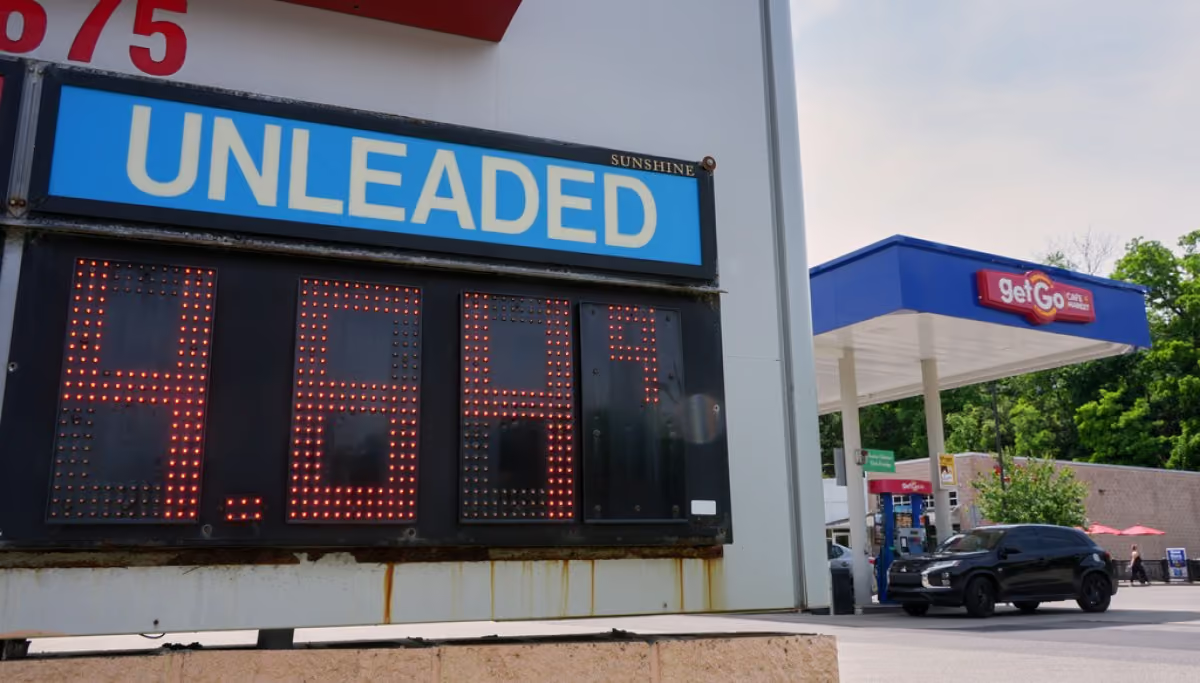
U.S. fuel retailers and independent rack marketers the distributors who buy gasoline in bulk at the terminal rack and resell to service stations face an estimated 5–15 cents per gallon of margin exposure starting immediately, as coordinated federal and state enforcement pressure threatens to compress the downstream pricing window that currently cushions their cost recovery.
The mechanism driving this story is not crude oil. Crude has fallen. The question is why retail prices at the pump have not followed at the same pace, and whether that lag reflects illegal conduct or the ordinary plumbing of fuel distribution. To understand the enforcement risk, you have to understand how retail gasoline is actually priced. Refiners buy crude, convert it to gasoline, and sell that gasoline into the wholesale market at what is called the rack price the published price at a fuel terminal for bulk pickup. The benchmark that moves rack prices is RBOB (Reformulated Blendstock for Oxygenate Blending) the futures price for unfinished gasoline traded on the New York Mercantile Exchange. RBOB itself adjusts to crude movements with a delay of one to two weeks, reflecting the time crude sits in transit, refinery throughput scheduling, and the mechanics of futures settlement. By the time a gallon reaches a pump, it has also absorbed state and federal excise taxes (averaging around 57 cents per gallon nationally), RIN costs Renewable Identification Numbers, the compliance credits oil companies must purchase under the Renewable Fuel Standard and distribution logistics. None of these costs move with crude in real time.
The DOJ and FTC letters, co-signed by Associate Attorney General Stanley Woodward Jr. and FTC Chair Andrew Ferguson according to reporting, were prompted in part by a June 24 Truth Social post in which President Trump claimed oil companies were not passing crude price declines through to consumers and urged the DOJ to investigate price gouging. The letters request state attorneys general to examine whether state emergency pricing laws have been triggered and to pursue antitrust or consumer protection actions under state statutes where appropriate. The federal agencies note they do not themselves enforce state price gouging laws those statutes vary significantly, with some tied to declared emergencies but they are signalling coordination and political backing for state-level action. The structural problem with treating the lag as presumptive evidence of manipulation is that the lag is a feature, not a bug, of how the supply chain physically operates. Investigative letters do not change refinery economics.
Here is what the margin anatomy actually looks like. Take a mid-sized rack marketer a regional fuel distributor purchasing 10 million gallons per month across three terminals in the Southeast. At current RBOB spot around $2.20/gallon, plus roughly 18 cents per gallon in distribution and blending costs, and a 57 cent average tax burden, the all-in cost before retail margin lands near $2.95/gallon. That marketer may be retailing at $3.10/gallon a gross margin of approximately 15 cents. If state emergency pricing enforcement caps that margin at, say, 8 cents a threshold that has appeared in prior state emergency declarations the operator loses roughly $700,000 per month in margin on that volume alone. That is not a rounding error for an independent distributor. It is the difference between a solvent operation and one drawing on credit lines to cover payroll.
The crack spread the difference between the price of refined gasoline and the cost of the crude oil used to produce it is the primary margin indicator for refiners. A 3-2-1 crack spread measures what a refinery earns processing three barrels of crude into two barrels of gasoline and one barrel of diesel. At the moment, NYMEX crack spreads for gasoline are running in a range consistent with healthy but not exceptional refining margins. If enforcement pressure accelerates retail price reductions without a corresponding decline in input costs crude, RINs, logistics the downstream margin compression does not disappear. It relocates: retailers absorb it first, then wholesalers, and eventually it reaches refinery gate economics. For integrated oil majors companies like ExxonMobil, Chevron, or Valero that span production, refining, and retail the exposure is manageable because upstream crude gains can offset downstream compression. For independent retailers and rack marketers, there is no upstream buffer.
On the buy side, commercial fuel buyers fleet operators, agricultural cooperatives, municipal transit systems purchasing diesel and gasoline on fixed-period contracts have an immediate incentive to watch this enforcement action closely. If state-level action succeeds in driving retail prices down even temporarily, buyers on month to month contracts benefit. Buyers locked into fixed price contracts signed in the past 60 days, when retail margins were wider, may find themselves above spot for a brief window. For larger buyers with the ability to use index linked pricing against OPIS (Oil Price Information Service, the benchmark used for most rack-level commercial fuel contracts), aligning contract resets to the next OPIS publication cycle makes sense given current downward pressure on RBOB.
On the sell side, the asymmetry of enforcement exposure is stark. A large integrated trader or national oil company's marketing arm with in-house legal teams, derivatives access, and diversified revenue across the barrel can weather a pricing audit and documentation request with relative ease. The cost is legal time, not margin. The same is not true for a smaller regional fuel retailer operating three or four stations, setting prices daily by reference to competitor signs and their most recent rack invoice. That operator has no pricing power, no derivatives book to hedge against margin compression, and no legal infrastructure to respond to an attorney general inquiry. For smaller operators, the practical step is documentation: price-setting records, rack invoices, and the timeline linking crude movements to their actual cost basis. In an enforcement environment, the inability to show the paper trail is the liability.
The elephant in the room the structural constraint this enforcement push largely ignores is that the entities with the least pricing power are the ones most exposed to headline risk. The major integrated companies set wholesale rack prices; independent retailers are price takers. A rack marketer buying at posted prices and setting retail at a few cents above their cost cannot manipulate a market they have no power to move. The antitrust tools available to DOJ are better suited to detecting coordinated pricing among competitors parallel pricing that exceeds what cost movements would explain than to addressing the mechanics of a supply chain that structurally lags crude by design. The legal and compliance advisory sector is the clearest near-term beneficiary: demand for antitrust counsel and downstream pricing audit services in the petroleum sector has already risen, and that demand will accelerate as state AGs begin formal inquiry processes.
For observers tracking this situation, the most time-bound and specific signal is the NYMEX RBOB crack spread particularly the front-month gasoline crack over the next 30 days. Watch for the spread to compress below $15/barrel, which would indicate that enforcement overhang is beginning to price into refinery margin expectations. A secondary signal is the OPIS rack average for the Southeast and Midwest the regions where state emergency pricing laws are most likely to be invoked which publishes daily and will show any retail price acceleration before it appears in AAA pump price averages. If the RBOB crack holds above $18/barrel while retail prices fall, compression is landing entirely on the retailer and distributor layer, not on refiners and that is the outcome most damaging to independent downstream operators. The 30 day window before mid-August is the critical enforcement calendar: attorneys general who respond to the DOJ/FTC invitation will need to open formal inquiries before summer driving demand cools and the political urgency of pump prices recedes.


.jpg)

'%3e%3cg id='Final-Copy-2_2_' transform='translate(1275.000000, 200.000000)'%3e%3cpath class='st0' d='M7.4,12.8h6.8l3.1-11.6H7.4C4.2,1.2,1.6,3.8,1.6,7S4.2,12.8,7.4,12.8z'/%3e%3c/g%3e%3c/g%3e%3c/g%3e%3cg id='final---dec.11-2020'%3e%3cg id='_x30_208-our-toggle' transform='translate(-1275.000000, -200.000000)'%3e%3cg id='Final-Copy-2' transform='translate(1275.000000, 200.000000)'%3e%3cpath class='st1' d='M22.6,0H7.4c-3.9,0-7,3.1-7,7s3.1,7,7,7h15.2c3.9,0,7-3.1,7-7S26.4,0,22.6,0z M1.6,7c0-3.2,2.6-5.8,5.8-5.8 h9.9l-3.1,11.6H7.4C4.2,12.8,1.6,10.2,1.6,7z'/%3e%3cpath id='x' class='st2' d='M24.6,4c0.2,0.2,0.2,0.6,0,0.8l0,0L22.5,7l2.2,2.2c0.2,0.2,0.2,0.6,0,0.8c-0.2,0.2-0.6,0.2-0.8,0 l0,0l-2.2-2.2L19.5,10c-0.2,0.2-0.6,0.2-0.8,0c-0.2-0.2-0.2-0.6,0-0.8l0,0L20.8,7l-2.2-2.2c-0.2-0.2-0.2-0.6,0-0.8 c0.2-0.2,0.6-0.2,0.8,0l0,0l2.2,2.2L23.8,4C24,3.8,24.4,3.8,24.6,4z'/%3e%3cpath id='y' class='st3' d='M12.7,4.1c0.2,0.2,0.3,0.6,0.1,0.8l0,0L8.6,9.8C8.5,9.9,8.4,10,8.3,10c-0.2,0.1-0.5,0.1-0.7-0.1l0,0 L5.4,7.7c-0.2-0.2-0.2-0.6,0-0.8c0.2-0.2,0.6-0.2,0.8,0l0,0L8,8.6l3.8-4.5C12,3.9,12.4,3.9,12.7,4.1z'/%3e%3c/g%3e%3c/g%3e%3c/g%3e%3c/g%3e%3c/svg%3e) Privacy Choices
Privacy Choices