.avif)
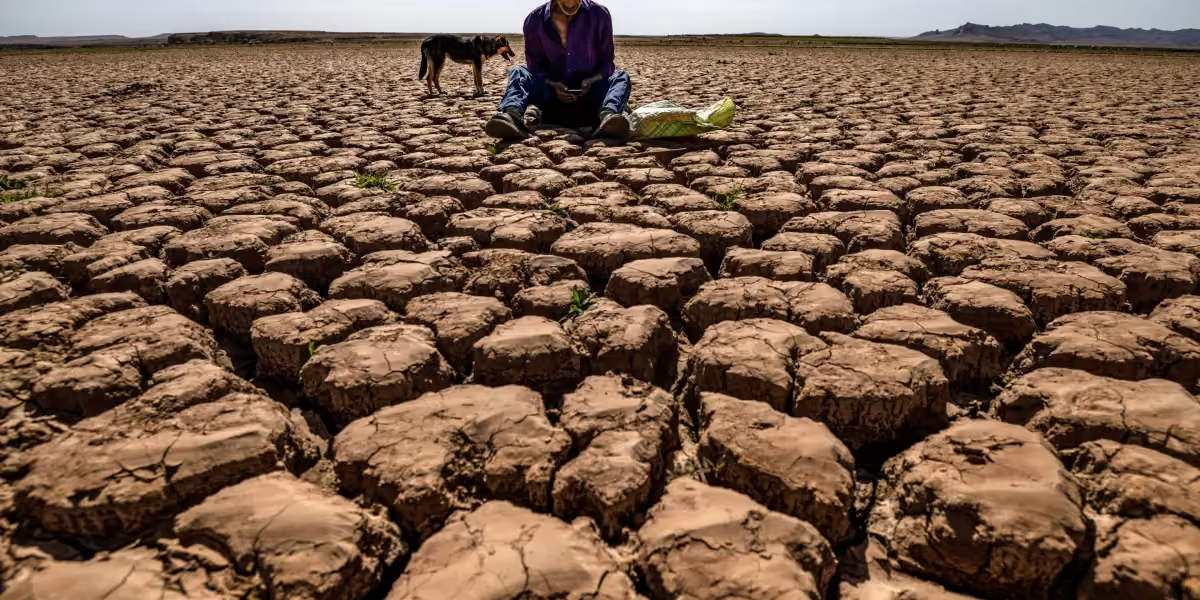
Wheat futures rose above $5.90 per bushel in early June as El Niño's emergence tightens already strained grain markets. Flour millers face input cost increases of roughly 28% for US Hard Red Winter wheat compared to May 2025, while grain storage operators with existing inventory capture widening price spreads as contango structures develop. CBOT July 2026 wheat futures settled at $5.83 per bushel on June 8, creating immediate margin pressure for feed manufacturers and food processors unable to immediately pass through higher costs to consumers.
El Niño the climate phenomenon which has taken shape across the equatorial Pacific and is expected to intensify in the months ahead threatens global crop production through droughts, floods, and temperature extremes. The pattern's impact varies critically by hemisphere and crop calendar. Its impacts are projected to intensify globally, including a wetter than usual winter in the southern US, drought and wildfire risks in Australia, and potential disruptions to the Atlantic hurricane season. Australian wheat harvest runs October to January, facing different El Niño phases than US winter wheat planting from September to November. Current forecasts show the development of an El Niño, with the highest forecasts suggesting an extreme "Super El Niño event" registering Pacific Ocean temperatures 2°C above normal. The FAO Cereal Price Index reflects this mounting pressure averaging 114.3 points in May, up 2.6% from April and 4.9% from its level a year earlier.
Consider a mid-sized grain trader shipping 50,000 tonnes of wheat from the US Gulf to Southeast Asia. At current freight rates of approximately $35 per tonne, transportation costs $1.75 million per cargo manageable when wheat prices were stable at $5.20 per bushel in March. But wheat futures fell to around $5.80 per bushel in early June, hitting their lowest level since April 10 before rebounding on El Niño concerns, creating volatile margin conditions. The 70 cent price swing per bushel translates to roughly $1.28 million difference in cargo value more than covering freight costs when prices rise, but eliminating profit entirely when they fall. Storage capacity constraints limit traditional hoarding strategies. Pakistani flour millers, despite the United States being at a low ebb for HRW wheat for another year, cannot meaningfully stockpile without detection by regulatory authorities monitoring artificial price manipulation.
On the buy side, flour mills and feed manufacturers face immediate input cost pressures without derivative hedging access. A regional cooperative processing 1,000 tonnes daily pays roughly $200,000 more per month for the same wheat volume compared to early 2025. These operators typically secure bilateral supply agreements with local elevators, fixing prices 30-90 days forward, but lack Chicago Board of Trade access for longer-term hedging. On the sell side, grain elevator operators with existing inventory benefit from the price rally but must balance storage costs against uncertain El Niño timing. The 2026-27 US winter wheat crop is expected to shrink 25% to 1.048 million bushels, the smallest since 1965, supporting prices even without weather disruptions. For integrated traders like Cargill or ADM with derivatives access, protective puts at $5.50 per bushel for December 2026 cost approximately 18 cents per bushel expensive insurance but manageable given margin volatility.
Market observers should monitor NOAA's June El Niño outlook, historically the most reliable forecast window for winter peak intensity. Seasonal El Niño forecasts become more reliable after June, making the June outlook especially important for assessing the likelihood of a winter peak. The Australian Bureau of Meteorology's wheat growing region rainfall forecasts, updated bi-weekly through September, will determine Southern Hemisphere crop potential before Northern Hemisphere planting decisions crystallize. El Niño developing from May to July is now 82% predicted and 96% certain from December to February, up from a 61% chance from May to July forecast a month ago. Current wheat rally assumes uniform weather risk, but crop calendars create asymmetric exposure windows where timing matters more than intensity.

.jpg)
'%3e%3cg id='Final-Copy-2_2_' transform='translate(1275.000000, 200.000000)'%3e%3cpath class='st0' d='M7.4,12.8h6.8l3.1-11.6H7.4C4.2,1.2,1.6,3.8,1.6,7S4.2,12.8,7.4,12.8z'/%3e%3c/g%3e%3c/g%3e%3c/g%3e%3cg id='final---dec.11-2020'%3e%3cg id='_x30_208-our-toggle' transform='translate(-1275.000000, -200.000000)'%3e%3cg id='Final-Copy-2' transform='translate(1275.000000, 200.000000)'%3e%3cpath class='st1' d='M22.6,0H7.4c-3.9,0-7,3.1-7,7s3.1,7,7,7h15.2c3.9,0,7-3.1,7-7S26.4,0,22.6,0z M1.6,7c0-3.2,2.6-5.8,5.8-5.8 h9.9l-3.1,11.6H7.4C4.2,12.8,1.6,10.2,1.6,7z'/%3e%3cpath id='x' class='st2' d='M24.6,4c0.2,0.2,0.2,0.6,0,0.8l0,0L22.5,7l2.2,2.2c0.2,0.2,0.2,0.6,0,0.8c-0.2,0.2-0.6,0.2-0.8,0 l0,0l-2.2-2.2L19.5,10c-0.2,0.2-0.6,0.2-0.8,0c-0.2-0.2-0.2-0.6,0-0.8l0,0L20.8,7l-2.2-2.2c-0.2-0.2-0.2-0.6,0-0.8 c0.2-0.2,0.6-0.2,0.8,0l0,0l2.2,2.2L23.8,4C24,3.8,24.4,3.8,24.6,4z'/%3e%3cpath id='y' class='st3' d='M12.7,4.1c0.2,0.2,0.3,0.6,0.1,0.8l0,0L8.6,9.8C8.5,9.9,8.4,10,8.3,10c-0.2,0.1-0.5,0.1-0.7-0.1l0,0 L5.4,7.7c-0.2-0.2-0.2-0.6,0-0.8c0.2-0.2,0.6-0.2,0.8,0l0,0L8,8.6l3.8-4.5C12,3.9,12.4,3.9,12.7,4.1z'/%3e%3c/g%3e%3c/g%3e%3c/g%3e%3c/g%3e%3c/svg%3e) Privacy Choices
Privacy Choices