.avif)
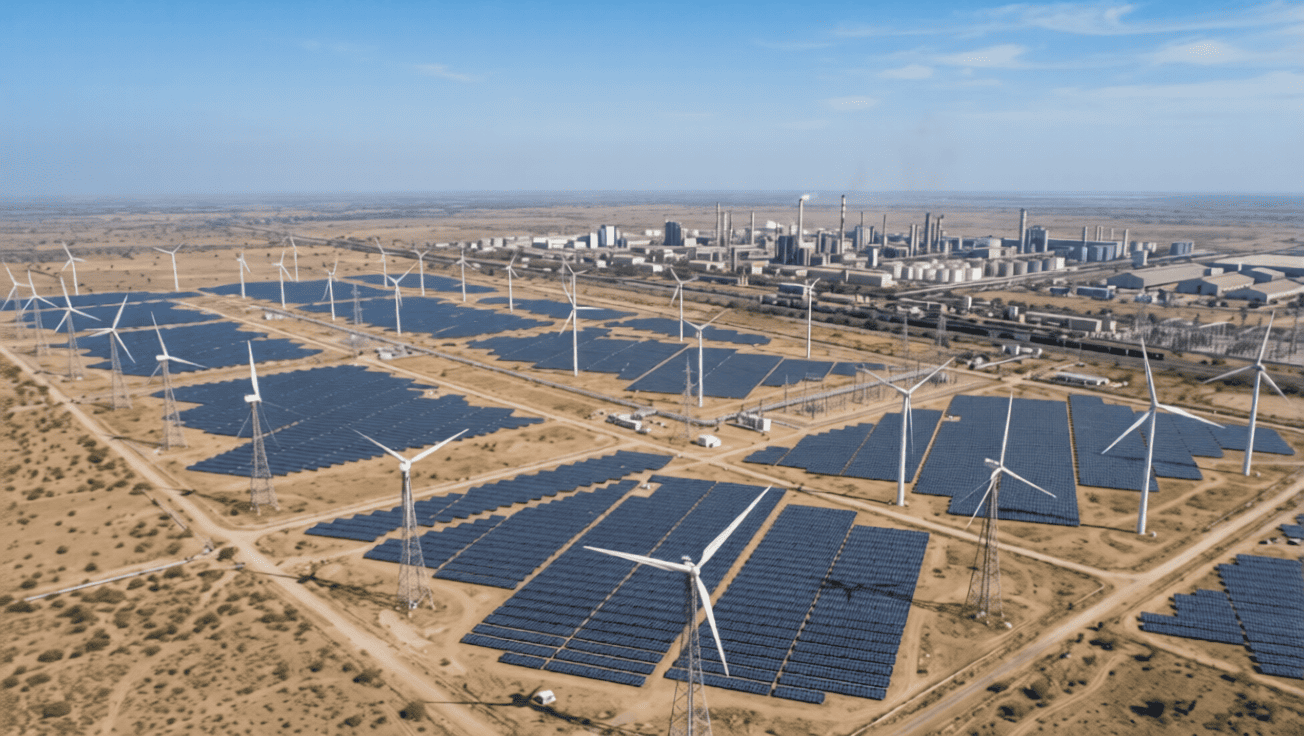
Gujarat Alkalies and Chemicals (GACL) is locking in a structural power cost advantage worth an estimated Rs 200–400 million per annum by contracting 160 MW of hybrid renewable capacity with commissioning expected in two phases beginning in 2026 at a moment when grid industrial tariffs in Gujarat run Rs 7–9 per unit against the renewable contracted rate of approximately Rs 3.0–4.5 per unit.
Power is not a secondary input in chlor-alkali manufacturing it is the feedstock. The electrolysis process that splits brine (a concentrated saltwater solution) into chlorine, caustic soda, and hydrogen consumes electricity at every stage. For GACL, which has scaled from an initial annual capacity of 37,425 tonnes to 852,400 tonnes per annum, power can constitute 40–60% of total production cost. The mechanism GACL is using is a group captive arrangement a structure permitted under India's Electricity Act in which an industrial consumer takes a minimum 26% equity stake in a generating project and commits to consuming at least 51% of its output, thereby legally qualifying for below grid tariff access. CleanMax Enviro Energy Solutions is developing 75.90 MW of wind and 84.34 MWp of solar the 'p' denoting peak output under standard test conditions across four Gujarat sites: Kalikanagar, Aji Dahisarda, Rajula, and Ghuntu. The combined 160 MW hybrid system is designed to generate approximately 369 million units of clean electricity annually, serving GACL's Dahej and Vadodara chlor-alkali plants.
Work the numbers at plant scale and the commercial logic sharpens. GACL's current grid exposure, assuming roughly 300 million units per annum of industrial consumption at Rs 8/unit, carries an annual power bill of approximately Rs 2.4 billion. At a contracted renewable rate of Rs 3.75/unit the midpoint of the Rs 3.0–4.5 range typical for group captive solar-wind hybrid projects in Gujarat the same consumption costs Rs 1.1 billion, a saving of Rs 1.3 billion per annum. Even netting out equity servicing obligations under the captive structure and two phase commissioning drag where only partial capacity delivers in the first year the annualised saving from year two onward comfortably exceeds Rs 200 million. On the sell side, Gujarat's state distribution companies (discoms) the utilities that distribute grid power to industrial consumers absorb the revenue loss directly. Large industrial consumers like GACL have historically cross-subsidised residential and agricultural tariffs; their exit into captive arrangements compresses the discom's revenue base and strains the cross-subsidy model that keeps domestic electricity affordable across the state.
Two structural risks sit behind the headline. First, the group captive regulatory arbitrage is time-limited. Indian electricity regulators the Central Electricity Regulatory Commission (CERC) and state equivalents have periodically tightened captive consumption compliance thresholds, and any future revision raising the equity or consumption minimums could force GACL to renegotiate or face grid surcharges that partially close the tariff gap. Second, the two-phase commissioning timeline remains unspecified in public disclosures. If wind capacity at Rajula or Ghuntu is delayed by grid connectivity approvals or equipment supply constraints both common in Gujarat's currently congested renewable pipeline GACL's Dahej site in particular remains exposed to grid tariff volatility during the gap period. For large integrated chemical producers with treasury access, an interest rate swap or bilateral fixed-price power purchase agreement (PPA) extension can bridge that exposure. For smaller regional chlor-alkali producers without derivatives access or group captive equity capacity, the practical equivalent is negotiating multi-year fixed-tariff bilateral contracts with discoms now, before further industrial exits tighten discom bargaining positions.
The forward signal for chlor-alkali operators and observers is specific: watch Gujarat Electricity Regulatory Commission (GERC) tariff order publications and captive consumption compliance circulars over the next 12 months. GERC has reviewed captive eligibility criteria in each of the last three regulatory cycles; a tightening of the 51% consumption threshold to, say, 60% would require GACL and any similarly structured producer to either increase captive off-take or reclassify a portion of consumption back onto the grid, erasing a meaningful fraction of the cost advantage. The second signal is commissioning confirmation: GACL's phased project milestones, once disclosed to BSE or NSE through regulatory filings, will indicate whether Dahej or Vadodara achieves full renewable supply before the next Gujarat grid tariff revision cycle. Operators benchmarking their own power procurement strategies should treat GACL's delivered cost once both phases are live as the new competitive floor for chlor-alkali production economics in India's western industrial corridor.

'%3e%3cg id='Final-Copy-2_2_' transform='translate(1275.000000, 200.000000)'%3e%3cpath class='st0' d='M7.4,12.8h6.8l3.1-11.6H7.4C4.2,1.2,1.6,3.8,1.6,7S4.2,12.8,7.4,12.8z'/%3e%3c/g%3e%3c/g%3e%3c/g%3e%3cg id='final---dec.11-2020'%3e%3cg id='_x30_208-our-toggle' transform='translate(-1275.000000, -200.000000)'%3e%3cg id='Final-Copy-2' transform='translate(1275.000000, 200.000000)'%3e%3cpath class='st1' d='M22.6,0H7.4c-3.9,0-7,3.1-7,7s3.1,7,7,7h15.2c3.9,0,7-3.1,7-7S26.4,0,22.6,0z M1.6,7c0-3.2,2.6-5.8,5.8-5.8 h9.9l-3.1,11.6H7.4C4.2,12.8,1.6,10.2,1.6,7z'/%3e%3cpath id='x' class='st2' d='M24.6,4c0.2,0.2,0.2,0.6,0,0.8l0,0L22.5,7l2.2,2.2c0.2,0.2,0.2,0.6,0,0.8c-0.2,0.2-0.6,0.2-0.8,0 l0,0l-2.2-2.2L19.5,10c-0.2,0.2-0.6,0.2-0.8,0c-0.2-0.2-0.2-0.6,0-0.8l0,0L20.8,7l-2.2-2.2c-0.2-0.2-0.2-0.6,0-0.8 c0.2-0.2,0.6-0.2,0.8,0l0,0l2.2,2.2L23.8,4C24,3.8,24.4,3.8,24.6,4z'/%3e%3cpath id='y' class='st3' d='M12.7,4.1c0.2,0.2,0.3,0.6,0.1,0.8l0,0L8.6,9.8C8.5,9.9,8.4,10,8.3,10c-0.2,0.1-0.5,0.1-0.7-0.1l0,0 L5.4,7.7c-0.2-0.2-0.2-0.6,0-0.8c0.2-0.2,0.6-0.2,0.8,0l0,0L8,8.6l3.8-4.5C12,3.9,12.4,3.9,12.7,4.1z'/%3e%3c/g%3e%3c/g%3e%3c/g%3e%3c/g%3e%3c/svg%3e) Privacy Choices
Privacy Choices