.avif)
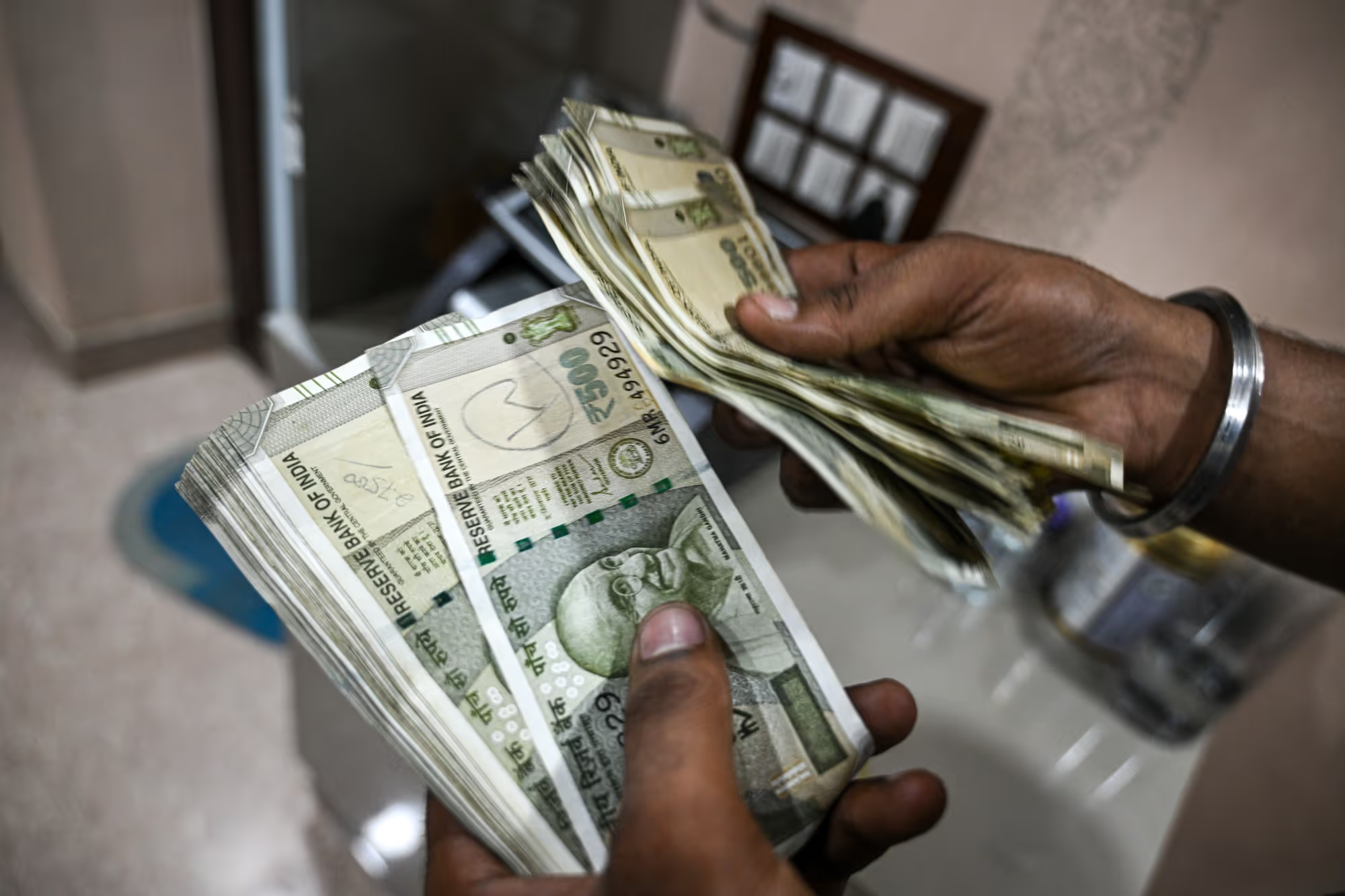
Indian crude buyers face a liquidity crunch that could force cargo deferrals within 48 hours as the rupee's slide past Rs 94.50 per dollar triggers financing constraints across operator scales. The rupee's 3.5% depreciation since the Iran conflict escalated has pushed Brent above $107/barrel, creating a double shock that widens India's current account deficit while simultaneously raising the cost of financing energy imports. For a typical 1 million barrel crude cargo valued at $107 million, the currency move alone adds roughly Rs 35-40 crore ($4.2-4.8 million) to the landed cost compared to pre-conflict exchange rates. Indian state oil companies like Indian Oil Corporation and Bharat Petroleum, which import roughly 85% of India's crude needs, now confront margin compression of $2-3 per barrel on their refining operations while facing tighter credit terms from domestic banks. The financing squeeze intensifies because most Indian commercial banks restrict commodity letters of credit (LC) the bank guarantees that enable international oil trade when daily foreign exchange volatility exceeds 2%, a threshold breached repeatedly this week.
On the buy side, large integrated refiners with established credit lines face working capital pressure but retain access to financing through diversified banking relationships and offshore credit facilities. Reliance Industries, with its sophisticated treasury operations, can tap dollar funding markets directly and use currency derivatives to hedge exposure, though hedging costs have risen sharply. However, mid-tier importers and regional distributors without derivatives access confront acute financing constraints as domestic banks pull back on commodity trade finance. A mid-sized fuel distributor seeking to finance a 35,000 tonne gasoil cargo now faces LC margins of 15-20% versus the typical 5-10%, effectively adding $350,000-700,000 to financing costs on a $35 million cargo. Private refiners like Nayara Energy, majority owned by Rosneft, face additional complexity as Western banks scrutinize financing linked to Russian entities, forcing reliance on a narrower pool of lenders and driving up financing costs by 50-100 basis points.
The margin anatomy reveals how currency volatility compounds energy inflation across India's petroleum supply chain. For state oil marketing companies (OMCs), the typical refining margin of $8-12 per barrel gets squeezed by both higher crude costs in rupee terms and the inability to immediately pass through currency impacts to regulated fuel prices. When the rupee weakens by 1%, it adds roughly Rs 0.80 per litre to petrol and diesel costs, but retail price adjustments lag by 2-3 days, creating temporary margin compression of Rs 15,000-20,000 crore ($1.8-2.4 billion) across the sector. Independent fuel retailers, who lack the integrated refiners' upstream margins, face immediate working capital stress as they must purchase refined products at higher rupee adjusted prices while competing with subsidized OMC retail outlets. The ripple effect extends to industrial consumers, where a textile mill or chemical plant using 1,000 tonnes of fuel oil monthly sees costs rise by Rs 8-10 lakh per month from currency effects alone, before accounting for the underlying commodity price increase.
Smaller operators face the most acute pressure as financing channels constrict rapidly when currency volatility spikes. Regional fuel distributors typically operate on 30-45 day payment cycles with working capital facilities sized for normal market conditions. A distributor with Rs 100 crore annual throughput suddenly needs an additional Rs 3-5 crore in working capital to maintain the same physical volumes, but finds banks reluctant to expand commodity linked credit lines during currency stress. These operators lack access to currency hedging tools available to larger players and cannot easily defer purchases, as they must maintain supply to retail networks. The financing crunch forces some to reduce cargo sizes or extend payment terms with suppliers, potentially disrupting fuel availability in smaller cities and rural areas. For independent petrol pump operators, the cash flow impact is immediate: a station selling 10,000 litres daily faces an additional Rs 80,000-100,000 monthly fuel cost purely from currency depreciation, money that must be financed upfront while retail collections remain unchanged.
Foreign portfolio investor outflows of over $10 billion in March signal deeper structural pressure on the rupee that could persist beyond immediate geopolitical tensions. The sell-off in Indian equities, with the Sensex dropping 1,282 points to 73,990, reflects broader concern about India's current account sustainability when oil prices remain elevated. Currency traders note that oil companies' consistent dollar buying to finance imports creates persistent downward pressure on the rupee, while exporters hold back rupee conversions in anticipation of further weakness. This dynamic creates a feedback loop where currency weakness raises import costs, which widens the current account deficit and puts further pressure on the rupee. The Reserve Bank of India's intervention capacity, while substantial with foreign exchange reserves of approximately $650 billion, faces limits when defending against both speculative attacks and genuine import demand. Market participants suggest the central bank is focused on managing volatility rather than defending specific levels, indicating acceptance that the rupee may weaken further if oil prices remain above $100 per barrel.
The two-speed financing market that has emerged separates operators with offshore funding access from those dependent on domestic credit, creating potential supply chain disruptions. Large trading houses like Vitol or Trafigura, which finance Indian crude imports through Singapore or London facilities, can continue normal operations while charging higher premiums to Indian counterparties facing domestic financing constraints. This arbitrage opportunity allows international traders to capture additional margin of $0.50-1.00 per barrel on Indian crude sales, effectively transferring part of India's financing stress to global commodity markets. Meanwhile, domestic commodity financing rates have spiked, with some banks quoting LC fees of 200-300 basis points above normal levels for petroleum products, compared to typical spreads of 50-100 basis points. The bifurcated market means that well capitalized operators can potentially benefit from competitors' financing difficulties, but overall system liquidity constraints threaten to reduce India's crude import capacity just as seasonal demand for transportation fuels typically increases ahead of the summer driving season.
Looking forward, the sustainability of India's petroleum import financing depends critically on oil price trajectory and rupee stability, with scenarios diverging sharply based on geopolitical developments. If crude prices stabilize below $100 and the rupee finds support around Rs 93-94, normal financing conditions could return within 2-3 weeks as banks rebuild confidence in commodity credit exposures. However, if tensions escalate further and push oil toward the $110-115 range mentioned in some scenarios, while driving the rupee toward Rs 98, India could face a more severe import financing crisis requiring government intervention. The central bank may need to provide special refinancing facilities for petroleum importers or relax regulatory constraints on commodity trade finance to prevent supply disruptions. For procurement managers across industries, the current episode demonstrates how quickly currency volatility can transform from a hedging consideration into an operational constraint, particularly for sectors dependent on imported raw materials. The experience reinforces the strategic value of diversified financing relationships and the operational flexibility that comes with access to derivative markets for currency and commodity risk management.


.jpg)
.jpg)

'%3e%3cg id='Final-Copy-2_2_' transform='translate(1275.000000, 200.000000)'%3e%3cpath class='st0' d='M7.4,12.8h6.8l3.1-11.6H7.4C4.2,1.2,1.6,3.8,1.6,7S4.2,12.8,7.4,12.8z'/%3e%3c/g%3e%3c/g%3e%3c/g%3e%3cg id='final---dec.11-2020'%3e%3cg id='_x30_208-our-toggle' transform='translate(-1275.000000, -200.000000)'%3e%3cg id='Final-Copy-2' transform='translate(1275.000000, 200.000000)'%3e%3cpath class='st1' d='M22.6,0H7.4c-3.9,0-7,3.1-7,7s3.1,7,7,7h15.2c3.9,0,7-3.1,7-7S26.4,0,22.6,0z M1.6,7c0-3.2,2.6-5.8,5.8-5.8 h9.9l-3.1,11.6H7.4C4.2,12.8,1.6,10.2,1.6,7z'/%3e%3cpath id='x' class='st2' d='M24.6,4c0.2,0.2,0.2,0.6,0,0.8l0,0L22.5,7l2.2,2.2c0.2,0.2,0.2,0.6,0,0.8c-0.2,0.2-0.6,0.2-0.8,0 l0,0l-2.2-2.2L19.5,10c-0.2,0.2-0.6,0.2-0.8,0c-0.2-0.2-0.2-0.6,0-0.8l0,0L20.8,7l-2.2-2.2c-0.2-0.2-0.2-0.6,0-0.8 c0.2-0.2,0.6-0.2,0.8,0l0,0l2.2,2.2L23.8,4C24,3.8,24.4,3.8,24.6,4z'/%3e%3cpath id='y' class='st3' d='M12.7,4.1c0.2,0.2,0.3,0.6,0.1,0.8l0,0L8.6,9.8C8.5,9.9,8.4,10,8.3,10c-0.2,0.1-0.5,0.1-0.7-0.1l0,0 L5.4,7.7c-0.2-0.2-0.2-0.6,0-0.8c0.2-0.2,0.6-0.2,0.8,0l0,0L8,8.6l3.8-4.5C12,3.9,12.4,3.9,12.7,4.1z'/%3e%3c/g%3e%3c/g%3e%3c/g%3e%3c/g%3e%3c/svg%3e) Privacy Choices
Privacy Choices