.avif)
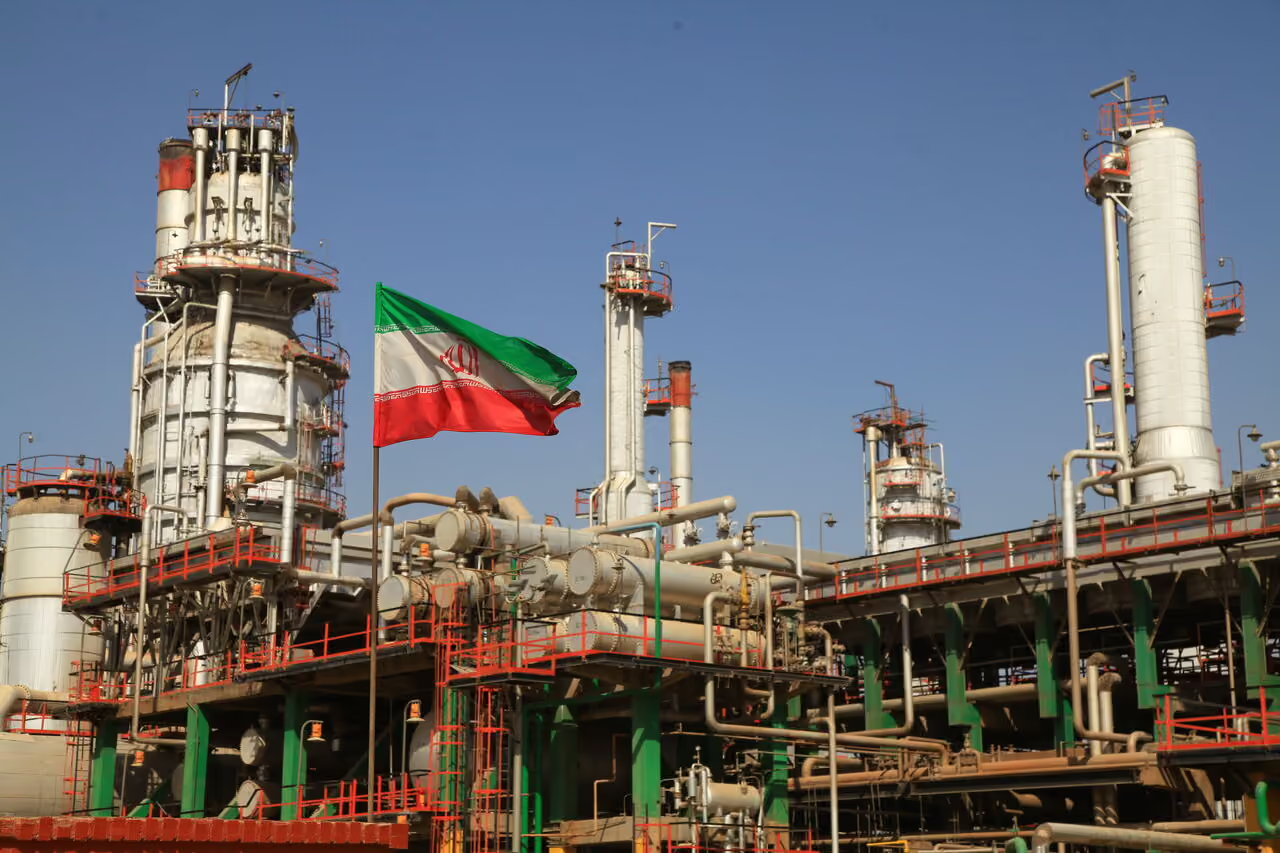
Asian state refiners buying Iranian crude could gain access to official barrels at a $3–8/barrel discount within 6–18 months of any verified deal but not before a compliance architecture stretching from Lloyd's P&I clubs to the US Treasury's Office of Foreign Assets Control (OFAC) formally lifts its blocks. That gap between political announcement and commercial reality is the central risk that crude oil traders must price today.
Iranian Parliament Speaker Mohammad Bagher Ghalibaf, speaking on 4 July 2026, publicly demanded that Washington accept a post-conflict shift in regional power dynamics as a precondition for sanctions relief and expanded trade. According to reports, he proposed joint Iran-Oman management of the Persian Gulf and the Strait of Hormuz paired with a reduced US military presence in the region. Indirect US-Iran negotiations on a 14-point MoU (Memorandum of Understanding a framework document establishing the terms of broader engagement) are reportedly narrowing, with Qatar and Pakistan signalling cautious optimism. These statements matter commercially not because a deal is done, but because they are moving the probability distribution for Hormuz normalisation and freight, crude differentials, and shadow fleet economics are all repricing around that shift.
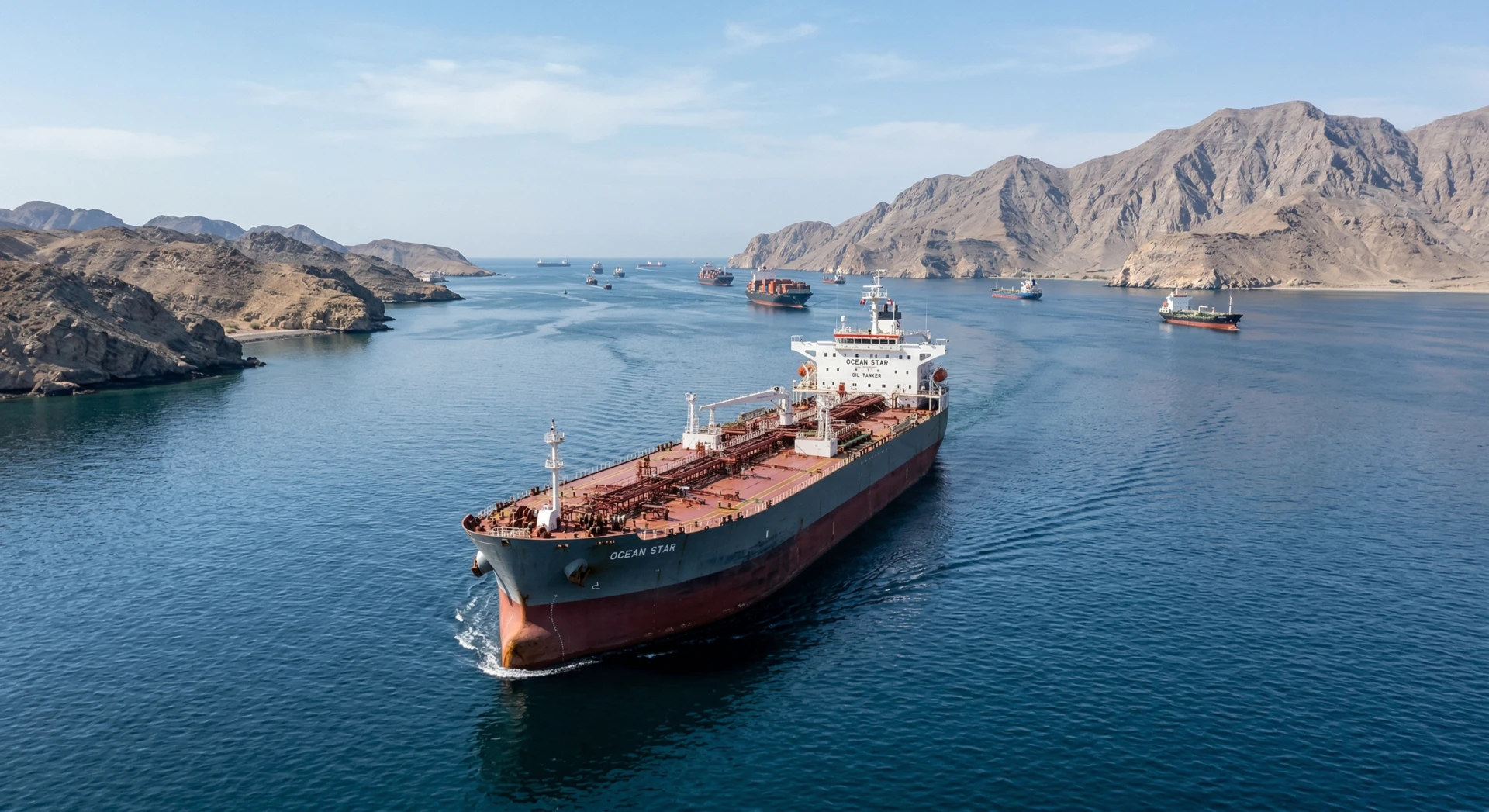
The physical supply chain grounding matters here. A VLCC (Very Large Crude Carrier a supertanker capable of loading roughly 2 million barrels) departing Kharg Island, Iran's primary crude export terminal in the northern Persian Gulf, transits the Strait of Hormuz and reaches Jebel Ali or Fujairah for lightering before continuing to Ulsan, South Korea, or Ningbo, China, in approximately 20–25 days. During the peak conflict-risk period of 2025–2026, mainstream operators rerouted or avoided this lane entirely, and some VLCC operators adopted Cape of Good Hope alternative routing adding roughly 10–14 days to voyage length and $1.5–3 million per round trip in additional bunker and charter costs. If Hormuz normalises for mainstream traffic, those voyage costs collapse back to pre-disruption levels almost immediately. The freight market reprices faster than any diplomatic process.
To understand where the margin sits, decompose a representative trade. Consider a Chinese independent refiner a so-called "teapot" currently buying Iranian crude through the shadow fleet at a delivered discount of $10–20 per barrel versus the Aramco Official Selling Price for equivalent sour grades. The discount exists because the cargo travels on non-compliant tonnage, under falsified documentation, through ship to ship transfer operations in Malaysian or Gulf of Oman waters, with no P&I (Protection and Indemnity the insurance that covers third-party liability for cargo damage, pollution, and crew injury) coverage from any mainstream club. If a credible sanctions relief deal is signed and Iran re-enters official trade flows, that discount compresses sharply likely to $3–8 per barrel because the risk premium that justified the $10–20 spread evaporates. The shadow fleet operators, and the traders who built their book around that arbitrage, lose the spread. The teapot refiners gain access to insured, bankable barrels, but pay more for the privilege.
On the buy side, the clear beneficiaries of credible normalisation are Asian state refiners South Korean NOC-affiliated buyers, Japanese refiners procuring under term contracts, and Indian PSU (Public Sector Undertaking state-owned refining entities including Indian Oil Corporation and HPCL) refiners who currently cannot touch Iranian crude without triggering secondary sanctions on their banking relationships. Indian PSU refiners have been sourcing Russian Urals and ESPO blend as their sanctioned-crude substitute; Iranian heavy and light grades would offer comparable specifications at potentially lower delivered cost, depending on OSP (Official Selling Price the monthly reference price set by a national oil company for term customers) levels and freight. On the sell side, NIOC (National Iranian Oil Company) and its trading intermediaries stand to gain official market access, higher netbacks (the price received at the wellhead after deducting transportation and processing costs), and the ability to write term contracts with bankable counterparties rather than relying on opaque intermediaries.
For large integrated traders a Vitol, Trafigura, or the trading arm of a national oil company the instrument to watch is the Brent-Dubai spread (the price differential between North Sea Brent crude and Middle Eastern Dubai crude), currently running at approximately $2–4 per barrel. Increased Iranian sour crude supply into the Middle East Gulf export system would expand the pool of Dubai-linked barrels, compressing the Brent-Dubai spread toward near-zero or even inverting it temporarily. A large trader with a long position in that spread betting on Brent's premium over Dubai widening faces mark to market losses on any credible deal headline. The hedging instrument is a Dubai swap position on ICE or CME, or an options structure on the spread itself. The cost of protection via options is currently modest, precisely because the market is still treating full normalisation as a tail scenario rather than the base case.
For smaller regional operators a mid-sized fuel importer in Southeast Asia, a regional blending house in the UAE, or an independent storage operator at Fujairah derivatives access is limited, but the practical exposure is real. These operators typically source product on 30–90 day rolling contracts priced off Platts Dubai assessments. If the Brent-Dubai spread compresses sharply following a deal announcement, the cost of Atlantic Basin crude relative to Gulf crude rises, and regional refiners running on Brent-linked feedstock see margin erosion without an obvious hedge. The practical mitigation is contract structure: locking in term supply agreements priced off Dubai rather than Brent for the next two quarters protects against the differential shift. Operators without that flexibility should build in a spread assumption of $1–2 per barrel rather than the current $3–4 when running forward margin models.
The timing mismatch is the critical variable that the political rhetoric obscures. Ghalibaf's framing treats the diplomatic layer as the binding constraint. It is not. Even if a 14-point MoU is signed, OFAC's enforcement architecture remains in place until the US Treasury formally amends its sanctions schedules and issues a General License (a legal instrument that permits a category of activity otherwise prohibited by sanctions regulations). Lloyd's P&I clubs and major commodity trade finance banks will not extend coverage until they receive that explicit OFAC guidance. Historically, from deal announcement to first sanctioned cargo delivery under official cover, the compliance pipeline runs 6–18 months. The last comparable precedent the 2015 JCPOA implementation saw Iranian crude re-enter mainstream European and Asian term contracts approximately eight months after Implementation Day, and that was with a fully negotiated, multilaterally verified framework. The current 14 point MoU, if confirmed, is a far more fragile instrument.
For observers tracking this situation in real time, the specific signal to watch through the end of Q3 2026 is the Baltic Dirty Tanker Index VLCC TD3C route Ras Tanura to Chiba in combination with the Platts Dubai-Brent EFS (Exchange of Futures for Swaps a derivative linking physical Dubai crude pricing to paper Brent). A sustained narrowing of the TD3C worldscale rate combined with Brent-Dubai spread compression below $1.50 per barrel would indicate that freight and derivatives markets are simultaneously pricing genuine Hormuz normalisation, not political noise. That combination has not appeared as of the 4 July 2026 report date. Until it does, Ghalibaf's declared shift in regional realities and a commercially actionable shift in crude trade flows remain two separate events, priced very differently by two different markets.

.jpg)
.jpg)

'%3e%3cg id='Final-Copy-2_2_' transform='translate(1275.000000, 200.000000)'%3e%3cpath class='st0' d='M7.4,12.8h6.8l3.1-11.6H7.4C4.2,1.2,1.6,3.8,1.6,7S4.2,12.8,7.4,12.8z'/%3e%3c/g%3e%3c/g%3e%3c/g%3e%3cg id='final---dec.11-2020'%3e%3cg id='_x30_208-our-toggle' transform='translate(-1275.000000, -200.000000)'%3e%3cg id='Final-Copy-2' transform='translate(1275.000000, 200.000000)'%3e%3cpath class='st1' d='M22.6,0H7.4c-3.9,0-7,3.1-7,7s3.1,7,7,7h15.2c3.9,0,7-3.1,7-7S26.4,0,22.6,0z M1.6,7c0-3.2,2.6-5.8,5.8-5.8 h9.9l-3.1,11.6H7.4C4.2,12.8,1.6,10.2,1.6,7z'/%3e%3cpath id='x' class='st2' d='M24.6,4c0.2,0.2,0.2,0.6,0,0.8l0,0L22.5,7l2.2,2.2c0.2,0.2,0.2,0.6,0,0.8c-0.2,0.2-0.6,0.2-0.8,0 l0,0l-2.2-2.2L19.5,10c-0.2,0.2-0.6,0.2-0.8,0c-0.2-0.2-0.2-0.6,0-0.8l0,0L20.8,7l-2.2-2.2c-0.2-0.2-0.2-0.6,0-0.8 c0.2-0.2,0.6-0.2,0.8,0l0,0l2.2,2.2L23.8,4C24,3.8,24.4,3.8,24.6,4z'/%3e%3cpath id='y' class='st3' d='M12.7,4.1c0.2,0.2,0.3,0.6,0.1,0.8l0,0L8.6,9.8C8.5,9.9,8.4,10,8.3,10c-0.2,0.1-0.5,0.1-0.7-0.1l0,0 L5.4,7.7c-0.2-0.2-0.2-0.6,0-0.8c0.2-0.2,0.6-0.2,0.8,0l0,0L8,8.6l3.8-4.5C12,3.9,12.4,3.9,12.7,4.1z'/%3e%3c/g%3e%3c/g%3e%3c/g%3e%3c/g%3e%3c/svg%3e) Privacy Choices
Privacy Choices