.avif)
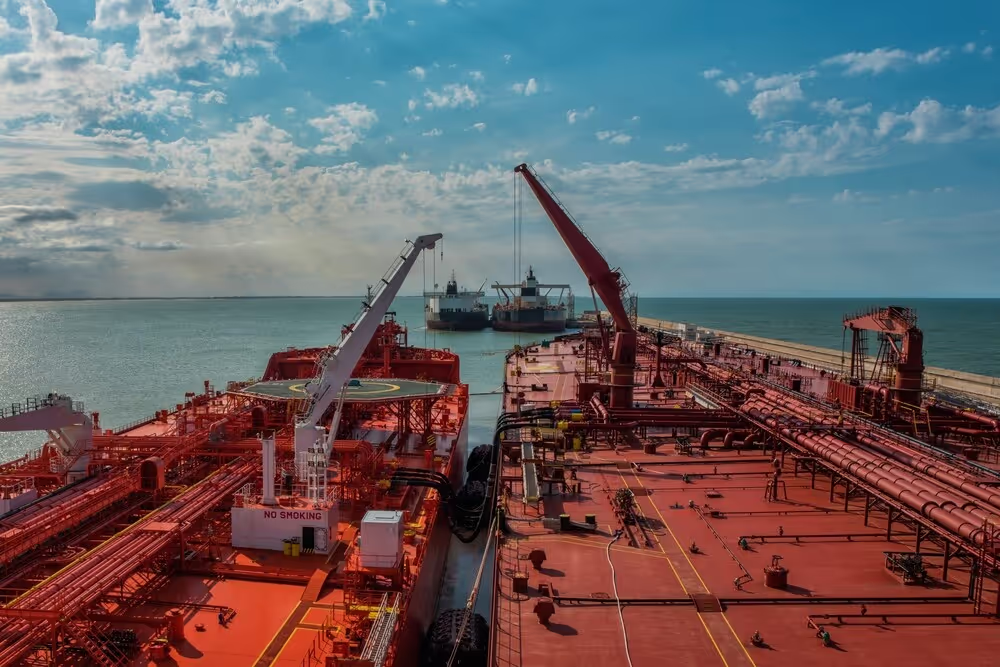
Philippine crude importers face a $400+ million supply shortfall as the US sanctions waiver on Russian oil expired April 11, forcing Petron Corporation — the country's sole remaining refinery operator — to process just 2.5 million barrels while shipments of at least four million barrels were cancelled due to Strait of Hormuz disruptions. Energy Secretary Sharon Garin said Manila is "very positive" about securing another window from Washington but warned that the country has "about 50 days' worth of petroleum supply," transforming what was manageable inventory cushion into potential energy emergency.
Brent crude trades at $101-104 per barrel, with Dated Brent — the real-world physical price — hitting $144, reflecting genuine barrel scarcity rather than paper futures speculation. For Philippine importers, this spread between futures and physical prices means emergency replacement volumes command premiums of $19.50 above benchmarks — levels that "never before" exceeded $10. A VLCC (Very Large Crude Carrier — a supertanker capable of carrying 2 million barrels) delivering emergency crude to Manila now costs $400-450 million in cargo value alone, compared to $320 million six weeks ago. Freight rates compound the burden: tanker charter costs have doubled to approximately $28/MT, adding $5.6 million per voyage that smaller importers cannot hedge.
The Philippines' refinery optimization reality exposes the "diversification" strategy's limitations. Petron currently operates the country's only remaining oil refinery which can process crude oil, configured for Russian Urals crude's sulfur content and density profile. Alternative suppliers including Colombia, Argentina, Canada and the US produce crude with different API gravity — the measure of oil density relative to water — requiring modified processing parameters. Colombian Cusiana crude, for instance, runs 45° API compared to Urals' 32° API, potentially reducing diesel yields by 8-12% and requiring expensive catalyst adjustments. The margin arithmetic is unforgiving: processing 100,000 barrels of mismatched crude costs an additional $180,000 in catalyst and energy consumption while producing 8,000 fewer barrels of diesel output.
On the buy side: Philippine fuel distributors — including Shell Philippines, Total Philippines, and regional cooperatives — face doubled diesel procurement costs as Metro Manila diesel prices reach ₱142-149 per liter, up from ₱75-80 per liter in February 2026. A mid-sized distributor importing 50,000 barrels monthly now pays an additional ₱45 million ($745,000) compared to pre-crisis pricing, with no derivatives access to hedge future deliveries. Many smaller operators have suspended forward purchases entirely, creating inventory gaps that larger players exploit. On the sell side: Petron Corporation benefits from inventory carrying advantages but confronts throughput constraints. Petron controls about 30 percent of the country's oil market and received 2.48 million barrels of Russian crude last month under the initial waiver. However, processing alternative crude grades reduces refinery utilization to 75-80% of nameplate capacity, compressing margins despite higher output prices.
For large integrated players: National oil companies with derivatives access — similar to Petronas or PTT — can structure collar options protecting against Brent moves above $110 while capturing upside to $130, costing approximately $3.2/barrel in premium. Complex refiners use crack spreads — the price difference between crude oil and refined products — to hedge processing margins, currently trading at $28-35/barrel for diesel in Singapore compared to $12-15 normally. For smaller regional operators: Philippine fuel importers without derivatives access rely on bilateral supply agreements with pricing reset monthly, effectively making suppliers their involuntary hedge counterparts. Regional distributors negotiate maximum price escalation clauses — typically limiting monthly increases to 15% — while building strategic inventory when possible. Some operators establish currency swaps with banks, protecting against peso depreciation that magnifies dollar-denominated fuel costs.
The financing dimension reveals where margin truly concentrates in this crisis. Letters of credit (LC) — bank guarantees that payment will be made once shipping documents are presented — now require 150% cash collateral for Russian crude purchases, compared to 110% for non-sanctioned suppliers. Philippine banks charge 4.5-6% annually for LC facilities backing petroleum imports, but Russian crude LCs command 8-12% rates reflecting sanctions risk. A $50 million crude cargo requires $6 million additional financing costs over six months compared to normal trade credit. Conversely, suppliers accepting Russian crude sales into the Philippines demand advanced payment or enhanced guarantees, shifting working capital burden to buyers. This financing asymmetry concentrates margin with suppliers who can self-finance — typically national oil companies or integrated traders — while squeezing independent importers relying on bank credit.
Freight control determines margin concentration in this disrupted trade lane. OPEC+ output fell by 7.9 million barrels per day in March due to the Strait of Hormuz shutdown, forcing longer Atlantic Basin routes that require VLCC vessels. Philippine imports traditionally moved on smaller Aframax tankers (750,000 barrels capacity) from Middle East suppliers, but alternative routes demand VLCCs from Colombia or US Gulf Coast — a vessel class Philippines rarely chartered directly. Established tanker operators with VLCC access — including Frontline, DHT Holdings, and Middle East-based carriers — capture $12-18 million per voyage premiums compared to normal rates. Independent cargo owners without vessel relationships pay spot charter rates that have tripled, while integrated oil companies with shipping arms (Shell, Total, Saudi Aramco's trading division) internalize freight profits.
Historically, the Philippines navigated energy disruptions through ASEAN (Association of Southeast Asian Nations) supply sharing mechanisms, but current crisis overwhelms regional capacity. Other Southeast Asian states, under the 1996 Petroleum Agreement, can help ease supply requirements, but can only provide 10 percent of the requirements — insufficient for 4+ million barrel shortfall. The last comparable supply emergency was the 1997 Asian Financial Crisis, when peso devaluation made fuel imports prohibitively expensive, but domestic production still operated. Current disruption is structural: the Philippines imports approximately 98% of its crude oil, leaving no domestic buffer when international supply chains fracture.
Russian crude suppliers gain 15-25% premiums for emergency replacement volumes, with Russian Urals crude reaching levels as much as $30 above Brent in recent weeks compared to historical $15-25 discounts to Brent since Ukraine invasion began. Moscow benefits from desperate Asian buyers bidding against each other for limited non-sanctioned supply. About half of Russia's 3.8 million barrels daily production goes to India and China, with China sourcing 20 percent of its oil supply from Russia — creating competition for Philippine emergency purchases. Alternative suppliers including Colombian Ecopetrol, Canadian heavy oil producers, and US shale operators command similar premiums, with Colombian crude trading $8-12 above Brent for prompt delivery compared to normal $2-4 discounts.
The political economy reveals deeper structural pressures beyond immediate supply mechanics. President Ferdinand Marcos Jr suspended excise tax on kerosene and liquefied petroleum gas but his economic team opposed suspending diesel and gasoline excise taxes, determining such moves would provide only "marginal relief" as wholesale cost increases dwarf tax savings. This fiscal constraint reflects Philippines' debt dynamics: suspending fuel excise taxes costs approximately ₱25-30 billion ($415-500 million) annually in foregone revenue when government borrowing costs have risen. Philippine ambassador to the United States Jose Manuel Romualdez said Manila is working with Washington "to secure waivers and exemptions" — language suggesting broader sanctions discussions beyond single transactions.
For observers tracking this crisis: monitor the Platts Dubai crude assessment versus Brent spread, currently $15-20 versus historical $2-4, indicating Asian physical market stress. A narrowing spread below $8 signals supply normalization within 30-45 days. Second, watch VLCC freight rates on the Colombia-Asia route: current $28/MT rates above $12/MT baseline indicate continued emergency procurement. Normal freight levels below $15/MT suggest alternative supply chains have stabilized. Third, track Philippines peso exchange rate pressure: sustained weakening beyond ₱62/$1 (currently ₱60.4/$1) indicates import financing stress overwhelming Central Bank intervention capacity.
'%3e%3cg id='Final-Copy-2_2_' transform='translate(1275.000000, 200.000000)'%3e%3cpath class='st0' d='M7.4,12.8h6.8l3.1-11.6H7.4C4.2,1.2,1.6,3.8,1.6,7S4.2,12.8,7.4,12.8z'/%3e%3c/g%3e%3c/g%3e%3c/g%3e%3cg id='final---dec.11-2020'%3e%3cg id='_x30_208-our-toggle' transform='translate(-1275.000000, -200.000000)'%3e%3cg id='Final-Copy-2' transform='translate(1275.000000, 200.000000)'%3e%3cpath class='st1' d='M22.6,0H7.4c-3.9,0-7,3.1-7,7s3.1,7,7,7h15.2c3.9,0,7-3.1,7-7S26.4,0,22.6,0z M1.6,7c0-3.2,2.6-5.8,5.8-5.8 h9.9l-3.1,11.6H7.4C4.2,12.8,1.6,10.2,1.6,7z'/%3e%3cpath id='x' class='st2' d='M24.6,4c0.2,0.2,0.2,0.6,0,0.8l0,0L22.5,7l2.2,2.2c0.2,0.2,0.2,0.6,0,0.8c-0.2,0.2-0.6,0.2-0.8,0 l0,0l-2.2-2.2L19.5,10c-0.2,0.2-0.6,0.2-0.8,0c-0.2-0.2-0.2-0.6,0-0.8l0,0L20.8,7l-2.2-2.2c-0.2-0.2-0.2-0.6,0-0.8 c0.2-0.2,0.6-0.2,0.8,0l0,0l2.2,2.2L23.8,4C24,3.8,24.4,3.8,24.6,4z'/%3e%3cpath id='y' class='st3' d='M12.7,4.1c0.2,0.2,0.3,0.6,0.1,0.8l0,0L8.6,9.8C8.5,9.9,8.4,10,8.3,10c-0.2,0.1-0.5,0.1-0.7-0.1l0,0 L5.4,7.7c-0.2-0.2-0.2-0.6,0-0.8c0.2-0.2,0.6-0.2,0.8,0l0,0L8,8.6l3.8-4.5C12,3.9,12.4,3.9,12.7,4.1z'/%3e%3c/g%3e%3c/g%3e%3c/g%3e%3c/g%3e%3c/svg%3e) Privacy Choices
Privacy Choices