.avif)
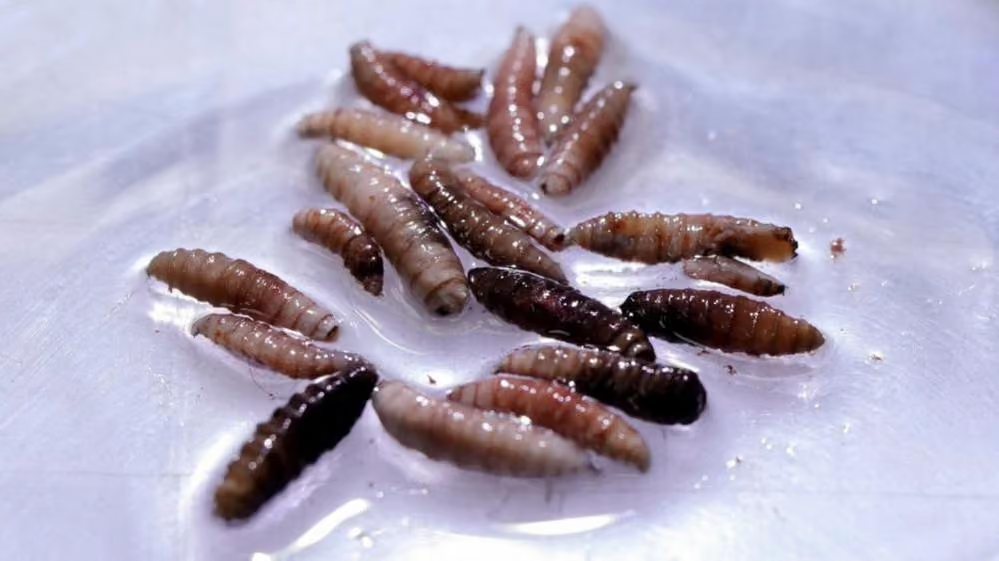
Southwestern cattle ranchers face rising per-head biosecurity costs starting now, with 12 confirmed U.S. screwworm cases as of mid-June 2026 and no operational domestic containment facility to slow an outbreak that has moved from Central America through Mexico to New Mexico in under two years.
The New World screwworm "Cochliomyia hominivorax", a fly whose larvae burrow into the living tissue of any warm-blooded animal, consuming flesh from the inside was eradicated from the United States 60 years ago using the sterile insect technique (SIT), a method in which vast numbers of radiation-sterilized male flies are released into the environment to mate with wild females, producing no offspring and collapsing the population over successive generations. SIT is the only proven eradication tool humanity has for this parasite. The problem is structural: the U.S. currently has no operational domestic sterile-fly production facility. The Texas facility that would supply sterile flies is still under construction. Until it is complete, the U.S. response depends on inspector training, veterinary treatment, and surveillance all useful, none sufficient. The first confirmed U.S. detection came June 8 in a Lea County, New Mexico, dog. State officials issued an emergency declaration the following day, unlocking additional state and federal assistance. Representatives Gabe Vasquez and Teresa Leger Fernández have since introduced the Protecting America's Herds Act, a bipartisan bill that would create a USDA grant program funding inspector training, identification protocols, treatment materials, and reporting infrastructure with explicit funding priority for states and tribal communities at greatest risk.
The commercial arithmetic for ranchers is already moving against them, even at current case counts. Consider a mid-sized New Mexico operation running 500 cow-calf pairs. Standard screwworm inspection a systematic visual and physical check of every wound, navel, and orifice on each animal takes roughly 10–15 minutes per head when conducted properly. At 500 head, that is 80–125 person-hours per inspection cycle, at prevailing ranch-labor rates of $18–22/hour in southeastern New Mexico, or $1,440–$2,750 per pass. If outbreak conditions require weekly inspection as biosecurity protocols in affected Mexican states have demanded that cost recurs every seven days. Add screwworm-specific treatment (ivermectin-based sprays and wound treatment compounds run approximately $4–8 per animal per application), and a 500 head operation is absorbing $3,400–$6,750 in additional operating cost per week before any animal loss is recorded. That is before accounting for the cost of movement restrictions. If New Mexico implements cattle movement controls a standard biosecurity response when a reportable parasite is confirmed livestock flows may reroute through Oklahoma, Kansas, and Colorado feedlot systems, adding freight and handling costs that the rancher, not the feedlot, typically absorbs.
On the buy side, feedlot operators and packers in the southern plains are watching closely. At 12 confirmed cases, the outbreak is contained enough that no major price signal has registered at the CME Live Cattle futures level. But feedlot buyers sourcing feeder cattle from New Mexico and West Texas understand that a supply disruption even a temporary movement restriction tightens the regional feeder supply and pushes feeder cattle prices upward. On the sell side, ranchers who need to move cattle this summer face the worst of both positions: higher on-ranch biosecurity costs, and potential movement restrictions that delay sale timing and compress their negotiating position with buyers. For large integrated cattle operations those with legal and veterinary staff, established relationships with state animal health officials, and the infrastructure to run daily surveillance the immediate response is to activate existing biosecurity protocols, document inspection records for regulatory compliance, and monitor USDA APHIS (Animal and Plant Health Inspection Service) zone designation updates, which will determine whether movement certificates are required. For smaller ranchers a family operation running 150–300 head in Lea or Eddy County without dedicated veterinary staff the practical equivalent is immediate contact with the New Mexico Cooperative Extension Service, which operates across all 33 New Mexico counties through New Mexico State University and provides free field guidance, treatment material sourcing, and reporting support.
The one signal that will tell observers whether this outbreak is being controlled or is beginning to escape containment is the USDA APHIS screwworm case count, updated on the agency's official situation report page. As of mid-June 2026, 12 confirmed U.S. cases have been reported. If that number doubles within 30 days a meaningful escalation threshold given the fly's reproductive cycle of roughly 21 days from egg to adult the window for administrative and training based response will have effectively closed, and the policy conversation will shift entirely to SIT capacity and emergency appropriations. Vasquez has indicated he will seek millions of dollars in funding the exact figure is pending legislative negotiation but congressional funding for inspector training cannot substitute for sterile-fly production capacity. Ranchers should watch the APHIS situation report weekly and treat any case confirmation within 100 miles of their operation as a trigger for immediate protocol activation, not a reason for measured monitoring. The sterile-fly facility timeline is the structural constraint that no grant program resolves; its completion date is the number that matters most, and it is not yet public.
.jpg)
'%3e%3cg id='Final-Copy-2_2_' transform='translate(1275.000000, 200.000000)'%3e%3cpath class='st0' d='M7.4,12.8h6.8l3.1-11.6H7.4C4.2,1.2,1.6,3.8,1.6,7S4.2,12.8,7.4,12.8z'/%3e%3c/g%3e%3c/g%3e%3c/g%3e%3cg id='final---dec.11-2020'%3e%3cg id='_x30_208-our-toggle' transform='translate(-1275.000000, -200.000000)'%3e%3cg id='Final-Copy-2' transform='translate(1275.000000, 200.000000)'%3e%3cpath class='st1' d='M22.6,0H7.4c-3.9,0-7,3.1-7,7s3.1,7,7,7h15.2c3.9,0,7-3.1,7-7S26.4,0,22.6,0z M1.6,7c0-3.2,2.6-5.8,5.8-5.8 h9.9l-3.1,11.6H7.4C4.2,12.8,1.6,10.2,1.6,7z'/%3e%3cpath id='x' class='st2' d='M24.6,4c0.2,0.2,0.2,0.6,0,0.8l0,0L22.5,7l2.2,2.2c0.2,0.2,0.2,0.6,0,0.8c-0.2,0.2-0.6,0.2-0.8,0 l0,0l-2.2-2.2L19.5,10c-0.2,0.2-0.6,0.2-0.8,0c-0.2-0.2-0.2-0.6,0-0.8l0,0L20.8,7l-2.2-2.2c-0.2-0.2-0.2-0.6,0-0.8 c0.2-0.2,0.6-0.2,0.8,0l0,0l2.2,2.2L23.8,4C24,3.8,24.4,3.8,24.6,4z'/%3e%3cpath id='y' class='st3' d='M12.7,4.1c0.2,0.2,0.3,0.6,0.1,0.8l0,0L8.6,9.8C8.5,9.9,8.4,10,8.3,10c-0.2,0.1-0.5,0.1-0.7-0.1l0,0 L5.4,7.7c-0.2-0.2-0.2-0.6,0-0.8c0.2-0.2,0.6-0.2,0.8,0l0,0L8,8.6l3.8-4.5C12,3.9,12.4,3.9,12.7,4.1z'/%3e%3c/g%3e%3c/g%3e%3c/g%3e%3c/g%3e%3c/svg%3e) Privacy Choices
Privacy Choices