.avif)
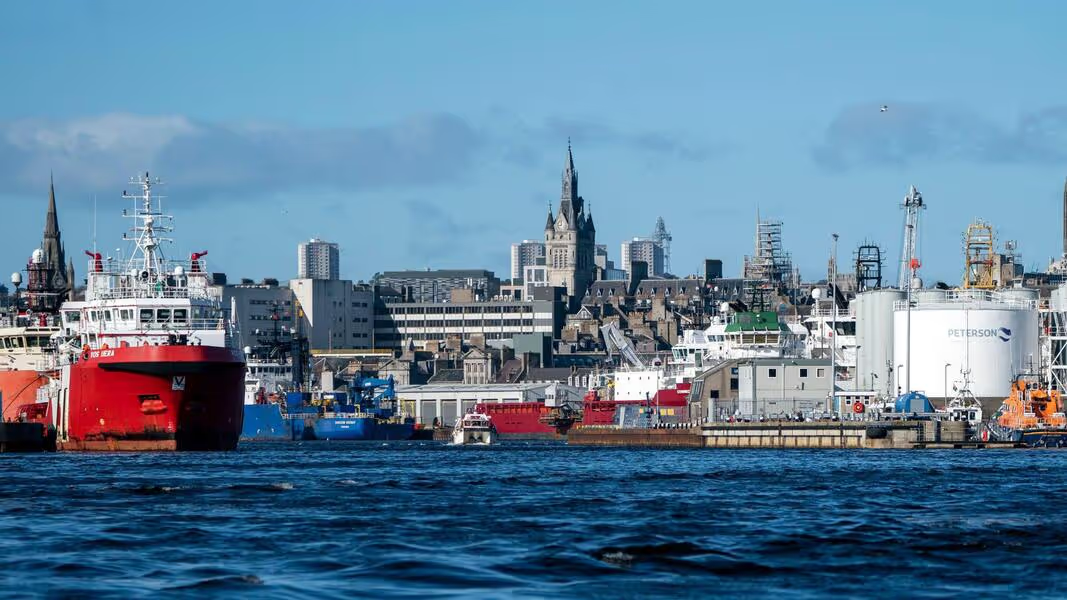
UK power generators face immediate margin pressure as day ahead baseload prices hit £104.50/MWh on Tuesday, driving winter 2026 forward contracts up 34p to £98.68/MWh amid geopolitical tensions and the government's Energy Independence Bill announcement. The legislation expected to expand Ofgem's regulatory reach over energy brokers and third-party intermediaries while accelerating clean energy infrastructure arrives as Brent crude surges past $120 per barrel following Iran's closure of the Strait of Hormuz, disrupting 20% of global oil supplies. For a 500MW combined cycle gas turbine (CCGT) generator running at 50% capacity factor, the £6.88/MWh increase in winter baseload adds roughly £15 million annually to forward revenue expectations. However, wind generation averaging 11.9 GW on Tuesday pushed CCGT output down to just 3.0 GW (12.2% of the mix), with nuclear outages across Heysham, Torness and Sizewell B capping baseload availability through summer.
The Energy Independence Bill a comprehensive legislative package targeting grid connection bottlenecks, planning delays, and energy affordability represents the UK government's response to what it terms "a second fossil fuel crisis in half a decade." Ministers position energy independence as "a long-term goal of national security," arguing that increased clean British energy production will "help to ensure that enemies of the United Kingdom cannot attack the economic security of the British people". The bill's three core pillars include expanding renewable energy capacity, reforming Ofgem's regulatory powers to cover energy brokers and intermediaries, and implementing recommendations from the Nuclear Regulatory Review. Ofgem's expanded remit will specifically target third-party intermediaries such as energy brokers, addressing long-standing concerns about unregulated market participants. Grid connection delays currently averaging 13 years for major renewable projects according to industry estimates remain the legislation's central target, though infrastructure capacity constraints persist regardless of regulatory reform.
TTF gas prices at €44.21/MWh reflect Europe's continued import dependency, trading 2-4x higher than Henry Hub ($2.82/MMBtu) due to transportation costs and supply constraints. The UK's vulnerability intensifies as Europe began 2026 with storage levels of 46 billion cubic metres, down from 60 bcm in 2025 and 77 bcm in 2024, placing pressure on industrial energy costs. For UK power generators, the immediate arithmetic shows acute tension: TTF front month settled at €46.68/MWh while UK storage sits at just 21% capacity, compared to continental sites ranging from 11% in Belgium to 65% in Spain. A typical 800MW CCGT plant consuming 12,000 MWh of gas daily faces input costs of approximately €560,000 per day at current TTF prices roughly €140,000 higher than the recent €30-35/MWh range. LNG spot prices have increased by over 140% in Asia following Qatar's force majeure declaration, with the IEA noting that each month without Strait of Hormuz shipments results in 10 bcm of LNG supply loss.
On the buy side: Independent power producers and smaller generators without long-term hedging face immediate cash flow pressure as spot gas costs spike alongside volatile renewables output. Regional electricity suppliers serving industrial customers cannot fully pass through escalating input costs under existing contracts, compressing margins by an estimated 15-25% compared to Q4 2025 levels. Industrial consumers particularly energy intensive manufacturers in chemicals, steel, and glass encounter dual pressure from higher electricity rates and direct gas costs, with some facilities already implementing demand-side reductions. On the sell side: Large integrated utilities with diverse generation portfolios benefit from higher power prices, particularly those with nuclear baseload and renewable capacity. Wind farm operators with fixed-price power purchase agreements capture windfall margins as electricity prices spike above contract levels, while gas peakers earn enhanced capacity payments during low wind periods. For nuclear operators, current market conditions vindicate long-term investment strategies as clean baseload becomes increasingly valuable.
The bill's grid infrastructure provisions address connection queue backlogs but cannot resolve physical network constraints or skilled workforce shortages that require years to develop. Planning reform may accelerate individual project approvals, yet the National Grid's £60 billion infrastructure upgrade timeline remains largely unchanged. Industry analysts note the legislation aligns with public sentiment favouring renewable investment over continued dependence on volatile Middle East supplies, particularly as North Sea oil and gas output continues its decline. For observers, the key signal emerges from the spread between UK baseload power prices and continental European benchmarks: monitor the UK-German power price differential through the Interconnector Capacity Mechanism auctions scheduled for 21 May. A widening spread above £15/MWh indicates structural supply stress that regulatory reform alone cannot address, while convergence suggests successful demand management and import capacity utilisation.





'%3e%3cg id='Final-Copy-2_2_' transform='translate(1275.000000, 200.000000)'%3e%3cpath class='st0' d='M7.4,12.8h6.8l3.1-11.6H7.4C4.2,1.2,1.6,3.8,1.6,7S4.2,12.8,7.4,12.8z'/%3e%3c/g%3e%3c/g%3e%3c/g%3e%3cg id='final---dec.11-2020'%3e%3cg id='_x30_208-our-toggle' transform='translate(-1275.000000, -200.000000)'%3e%3cg id='Final-Copy-2' transform='translate(1275.000000, 200.000000)'%3e%3cpath class='st1' d='M22.6,0H7.4c-3.9,0-7,3.1-7,7s3.1,7,7,7h15.2c3.9,0,7-3.1,7-7S26.4,0,22.6,0z M1.6,7c0-3.2,2.6-5.8,5.8-5.8 h9.9l-3.1,11.6H7.4C4.2,12.8,1.6,10.2,1.6,7z'/%3e%3cpath id='x' class='st2' d='M24.6,4c0.2,0.2,0.2,0.6,0,0.8l0,0L22.5,7l2.2,2.2c0.2,0.2,0.2,0.6,0,0.8c-0.2,0.2-0.6,0.2-0.8,0 l0,0l-2.2-2.2L19.5,10c-0.2,0.2-0.6,0.2-0.8,0c-0.2-0.2-0.2-0.6,0-0.8l0,0L20.8,7l-2.2-2.2c-0.2-0.2-0.2-0.6,0-0.8 c0.2-0.2,0.6-0.2,0.8,0l0,0l2.2,2.2L23.8,4C24,3.8,24.4,3.8,24.6,4z'/%3e%3cpath id='y' class='st3' d='M12.7,4.1c0.2,0.2,0.3,0.6,0.1,0.8l0,0L8.6,9.8C8.5,9.9,8.4,10,8.3,10c-0.2,0.1-0.5,0.1-0.7-0.1l0,0 L5.4,7.7c-0.2-0.2-0.2-0.6,0-0.8c0.2-0.2,0.6-0.2,0.8,0l0,0L8,8.6l3.8-4.5C12,3.9,12.4,3.9,12.7,4.1z'/%3e%3c/g%3e%3c/g%3e%3c/g%3e%3c/g%3e%3c/svg%3e) Privacy Choices
Privacy Choices