.avif)
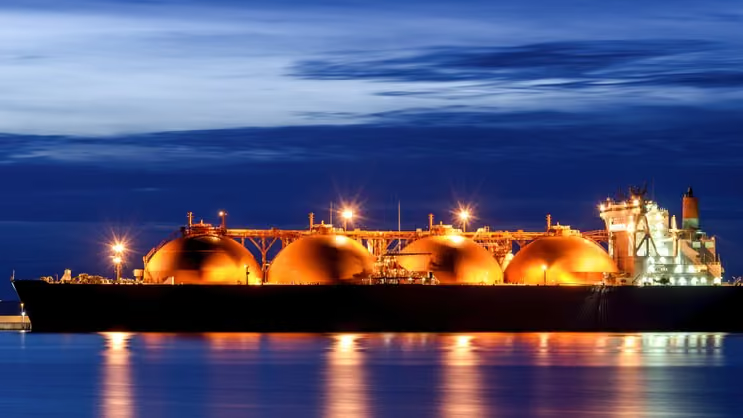
Woodside Energy will pay US$225 million plus cash call reimbursements to acquire PetroChina's 10.67% Browse Joint Venture stake, exercising pre-emption rights that block Inpex's planned acquisition and raise Woodside's interest to 41.27%. The timing leverages severe LNG market disruption: Iranian closure of the Strait of Hormuz since March 4, 2026, and drone attacks on Qatar's Ras Laffan facilities have removed approximately 20% of global LNG supply from reliable transit routes. With JKM prices at $18.92/MMBtu up 51.85% year on year undeveloped gas resources now carry option premiums that justify higher acquisition costs. A pre-emption right the contractual ability of existing joint venture partners to match third-party offers and block external buyers is the mechanism allowing Woodside to override PetroChina's preferred sale to Inpex on identical terms.
Browse represents Australia's largest undeveloped conventional gas resource with potential production of 11.4 million tonnes per annum of LNG, LPG and domestic gas. But conventional understates the complexity: Browse gas contains 8–15% carbon dioxide requiring expensive acid gas removal before liquefaction, fundamentally altering project economics versus standard LNG developments. The US$175 million contingent payment triggers only upon final investment decision for the Brecknock, Calliance and Torosa fields by June 30, 2032 acknowledging that Browse development remains uncertain despite a decade of study. For context: PetroChina originally acquired its Browse stake in December 2012 for $1.63 billion from BHP, meaning the current US$225 million exit represents approximately 85% capital loss over 14 years.
On the buy side: Woodside's combined upstream Browse resource and North West Shelf onshore infrastructure creates integrated development optionality that could deliver returns across the value chain. The Browse to NWS pipeline concept eliminates the need for floating LNG infrastructure, reducing capital requirements by an estimated $8–12 billion compared to offshore development. Current ownership structure positions Woodside (41.27%) as the largest stakeholder after BP (44.33%), with Japan Australia LNG holding 14.40%. On the sell side: PetroChina exits a stranded asset that consumed capital for over a decade without returns, reallocating resources toward producing fields and established LNG positions in more accessible geographies.
For large integrated LNG developers (QatarEnergy, Chevron, Shell's LNG divisions): Browse's 11.4 mtpa potential represents meaningful scale in a supply constrained market, but the 8–15% CO2 content requires acid gas removal technology that only major operators can finance and execute. The contingent payment structure essentially creates a call option on Browse development if FID occurs by 2032, the total acquisition cost rises to US$400 million, still modest for a resource of this scale. For smaller regional gas players mid-sized Australian producers, Asian LNG importers without upstream exposure Browse remains financially inaccessible due to multi-billion development requirements and technical complexity that demands major oil company capabilities.
Watch Browse Joint Venture partner statements through Q3 2026. Woodside CEO Liz Westcott describes the acquisition as "disciplined and capital efficient" but the real signal comes from BP's reaction as 44.33% holder, BP retains effective veto power over development concepts. If BP endorses the Browse to NWS integration, expect Woodside to accelerate engineering studies. If BP pushes alternative development routes or delays timeline discussions, the US$400 million total payment becomes speculative premium on an indefinitely deferred project. For observers: monitor monthly JKM forward curves beyond 2028 sustained premiums above $15/MMBtu indicate structural undersupply that justifies Browse development capital.
'%3e%3cg id='Final-Copy-2_2_' transform='translate(1275.000000, 200.000000)'%3e%3cpath class='st0' d='M7.4,12.8h6.8l3.1-11.6H7.4C4.2,1.2,1.6,3.8,1.6,7S4.2,12.8,7.4,12.8z'/%3e%3c/g%3e%3c/g%3e%3c/g%3e%3cg id='final---dec.11-2020'%3e%3cg id='_x30_208-our-toggle' transform='translate(-1275.000000, -200.000000)'%3e%3cg id='Final-Copy-2' transform='translate(1275.000000, 200.000000)'%3e%3cpath class='st1' d='M22.6,0H7.4c-3.9,0-7,3.1-7,7s3.1,7,7,7h15.2c3.9,0,7-3.1,7-7S26.4,0,22.6,0z M1.6,7c0-3.2,2.6-5.8,5.8-5.8 h9.9l-3.1,11.6H7.4C4.2,12.8,1.6,10.2,1.6,7z'/%3e%3cpath id='x' class='st2' d='M24.6,4c0.2,0.2,0.2,0.6,0,0.8l0,0L22.5,7l2.2,2.2c0.2,0.2,0.2,0.6,0,0.8c-0.2,0.2-0.6,0.2-0.8,0 l0,0l-2.2-2.2L19.5,10c-0.2,0.2-0.6,0.2-0.8,0c-0.2-0.2-0.2-0.6,0-0.8l0,0L20.8,7l-2.2-2.2c-0.2-0.2-0.2-0.6,0-0.8 c0.2-0.2,0.6-0.2,0.8,0l0,0l2.2,2.2L23.8,4C24,3.8,24.4,3.8,24.6,4z'/%3e%3cpath id='y' class='st3' d='M12.7,4.1c0.2,0.2,0.3,0.6,0.1,0.8l0,0L8.6,9.8C8.5,9.9,8.4,10,8.3,10c-0.2,0.1-0.5,0.1-0.7-0.1l0,0 L5.4,7.7c-0.2-0.2-0.2-0.6,0-0.8c0.2-0.2,0.6-0.2,0.8,0l0,0L8,8.6l3.8-4.5C12,3.9,12.4,3.9,12.7,4.1z'/%3e%3c/g%3e%3c/g%3e%3c/g%3e%3c/g%3e%3c/svg%3e) Privacy Choices
Privacy Choices